
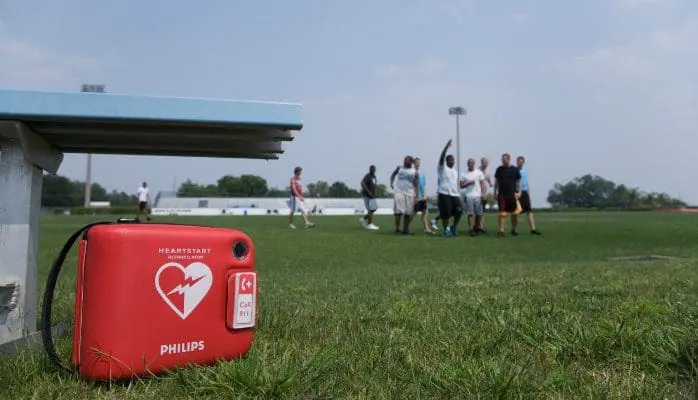
Should My Sports Team Have a AED?
 According to the British Heart Foundation, 60,000 people each year suffer a cardiac arrest outside a hospital.
A casualty suffering from cardiac arrest is very unlikely to survive without an Automatic External Defibrillator (AED), with survival rates as low as 5%.
However if defibrillation is delivered promptly, survival rates can be as high as 74%. Optimal conditions for defibrillation are present only for the first few minutes after the cardiac arrest. Success rates decrease thereafter by around 10% per minute of delay.
The UK Resuscitation Council’s guidelines on the use of automated external defibrillators state:
“The scientific evidence to support early defibrillation is overwhelming; the delay from collapse to delivery of the first shock is the single most important determinant of survival. If defibrillation is delivered promptly, survival rates as high as 75% have been reported.”
If we have to wait for the paramedics with their AED to arrive at the sporting venue, particularly at a more remote location, it is unlikely they will arrive in time to save the casualties life.
Should My Sports Team Have a AED? Yes – absolutely.
What is an AED?
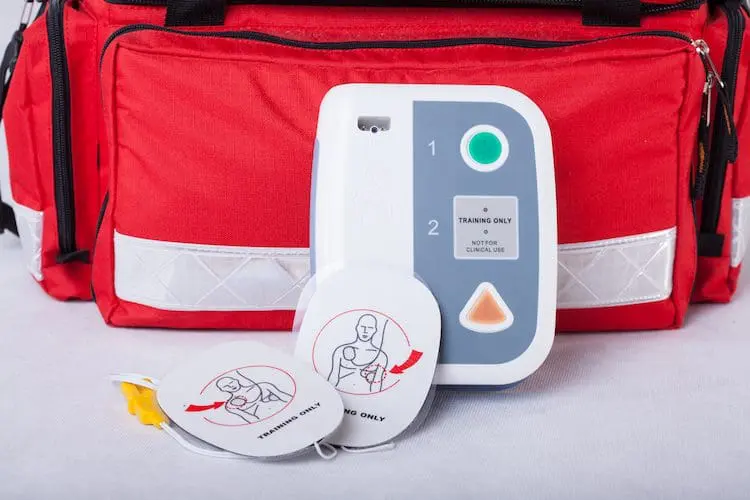
An AED is a computer and battery with two self-adhesive pads that attach to the casualty’s chest. These receive heart signals from the casualty to indicate if an electric shock is required to reset the heart. The AED will only shock a heart that is not working effectively and in conjunction with electronic voice prompts, an AED will tell you what to do. An AED is not considered a replacement for CPR, but is an integral part of the survival chain for people who had a cardiac arrest.
Modern AEDs are safer, lighter and more portable and well worth for the investment for a sports club.
Why use an AED?
- Heart disease is one of the UK’s greatest killers
- More than 60,000 sudden cardiac arrests take place each year
- In a sudden cardiac arrest emergency, time is of essence, which is why having an AED could make the difference between life and death.
When to use an AED?
A collapsed, non-breathing casualty is considered to have had a ‘Cardiac Arrest’. These casualties need CPR (current recommended guidance is 30 chest compressions and 2 rescue breaths continuously) and early defibrillation with an AED. Training to learn CPR and AED use is simple and non technical.
To watch a video of how to use an AED:
Never hesitate to use an AED, even if you haven’t been trained to use one. Turn it on and follow the voice prompts. It will tell you what to do.
Should My Sports Team Have a AED? What do you think? Let us know.