Updated April 2024

1. How do you check for breathing?
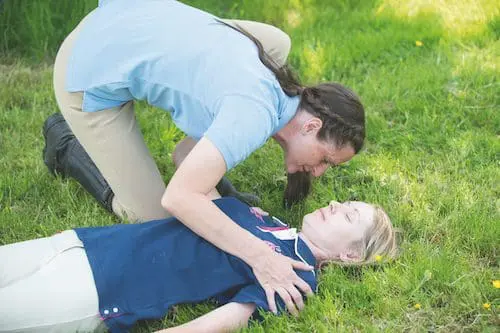
To check for breathing in an unconscious casualty, open and maintain their airway – tilt their head and lift their chin to move the tongue from the back of their throat. Then, look, listen and feel for breathing. Look at their belly for movement, listen for their breathing by putting your ear at their mouth, feel their breath strength with your ear at their mouth. Make these observations for up to 10 seconds. Most adults will breath 2-3 breaths in 10 seconds.
2. If someone is not breathing:
Call for an ambulance on 999/112 or ask a bystander to do so. Tell them you have an unresponsive casualty who is not breathing. Tell them exactly where you are (paddock, stables, arena, room).
3. Get an AED / defibrillator brought to you.
Make sure you ask someone to go an get the local AED / defibrillator straight away. It is good to know where the nearest defibrillators are in your life – knowing this before you need it may save a life. Get to know where the nearest one is to home, place of work and somewhere you visit regularly. Watch our video on how to do CPR and use defibrillator here.
4. If an adult is not breathing:
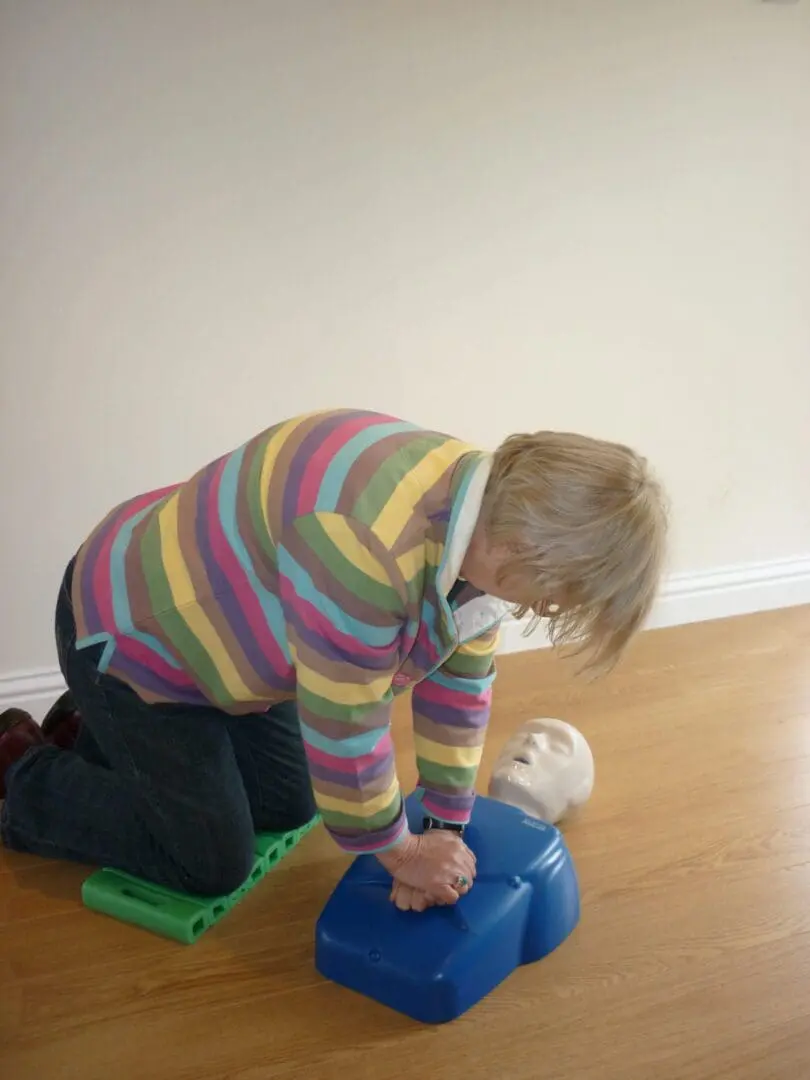
If it’s an adult casualty, you can then start to perform chest compressions and rescue breaths if you can:
- Place your hands in the centre of their chest (along what would be the male nipple line);
- Keeping your arms straight, use the heels of your hands to apply pressure.
- Make 30 compressions, to a depth of a third of the chest and at a rate of 100-120 per minute, in a bid to pump blood and oxygen around the body.
- Pinch the nose, and take a breath and place your lips around their mouth and blow steadily into their mouth and repeat once more, whilst maintaining an open airway;
- Repeat 30 compressions and 2 breaths until the ambulance arrives, your casualty recovers, or you become are too exhausted to carry on (watch the video below to see adult CPR)
Watch our video on how to do CPR and use an AED/defibrillator
5. If a child is not breathing: there is a slight change to the procedure compared to adults:
If it is a child casualty, carry out 5 rescue breaths before you start chest compressions (watch the video below to see child CPR). Continue for 1 minute then phone 999 – or get someone else to call. Thereafter continue with 30 compressions followed by 2 rescue breaths until help arrives.
On a child, use one hand and compress the chest about 1/3 of the depth of the body. Watch our video on how do CPR on a CHILD here.
On an infant (12 months and under) grasp the torso and use your thumbs to do compressions. Watch our video on how to do CPR on an INFANT.
6. Does doing CPR break a casualty’s ribs?
Yes, this may happen, especially in adults. 1 in 8 out-of-hospital CPR attempts in 2017-18 resulted in broken ribs. Compressions need to be vigorous and deep to be effective. However, do not let the chance of breaking a rib stop you from doing effective CPR. Ribs can be fixed afterwards, loss of life cannot!
7. What are agonal breaths?
IF the casualty shows signs of agonal breathing, continue your CPR as normal. Don’t stop! ‘Agonal breaths’ is a medical term for gasping. As your working away on someone’s chest, odd gasps are not unusual. These occasional gasps are not a sign that they are breathing again. A normal rate of breathing is 12-18 per minute for an adult, 25 + for a child.

8. How to use a AED/defibrillator:
When the AED arrives, unpack the contents and locate the battery/power pack and the pads appropriate to the age of the casualty. AEDs are safe for non-experts or trained people to use. Just turn the machine on using the green button and do what it tells you.
9. Can you use an AED on someone with a pacemaker or internal defibrillator?
If you have started CPR and someone brings an AED don’t be afraid to use it if the casualty has a Pacemaker under their skin. If the casualty is lying on the ground not breathing, then the pacemaker is ineffective so use the AED! The same applies to someone with an internal defibrillator. Generally, these devices are places in the top left of the chest so away from where you will be putting the AED pads.
10. Get a defibrillator for your site:
All of our first aid courses include training in doing CPR and using a defibrillator. It is a lifesaving skill and you just don’t know when you may need it. It is essential to get a defibrillator onto a casualty quickly, preferably within 5 minutes. There is funding available to help buy deifbrillators. Read about funding for defibrillators in this blog.
Get confident – get trained!
The best way to feel confident about dealing with first aid incidents is to take a specialist first aid course. To find out which first aid course is best for you check out our specific equestrian first aid webpage.
Everyone on our courses receives a FREE digital first aid manual. We have a range of manuals relevant to the courses we teach – Outdoor, Equestrian, First Aid at Work, Paediatric and Sports. They are a great resource that you can download onto your phone or other device and have all that first aid knowledge at your fingertips. You can view them and buy them for less than £5 here.
We have also produced an equestrian specific Accident Book for horse riding establishments. You can view and buy it here.

Medi-K and First Aid Training Co-operative have come together to run specialist equestrian specific first aid courses. For more information about our first aid courses please contact us.