
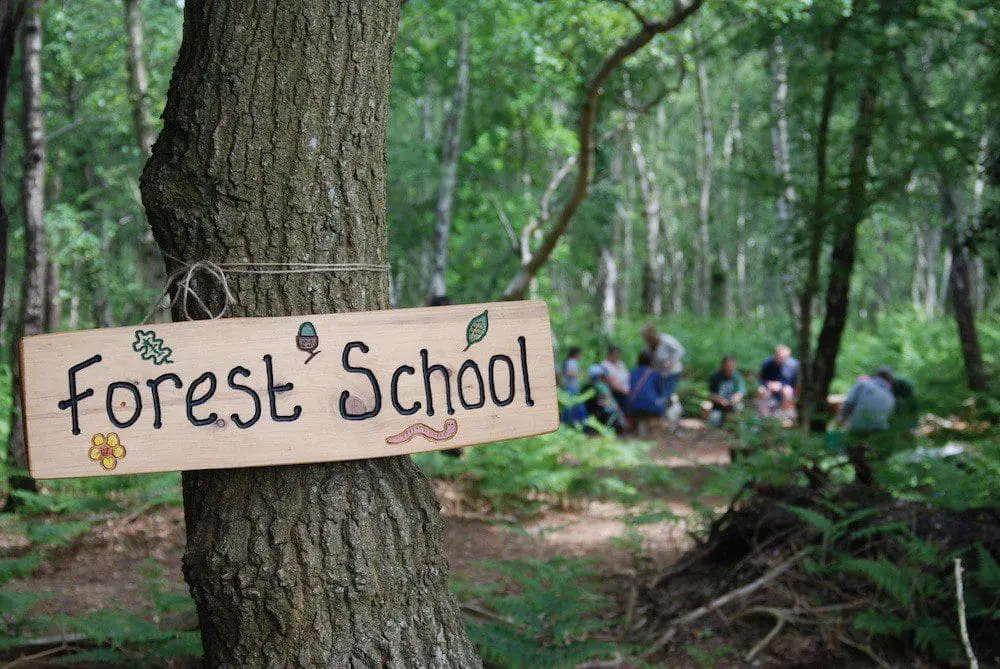

Forest school is a form of outdoor education, which aims to challenge traditional education concepts by encouraging children to explore nature, work as a team and learn through independent play.
The concept of a Forest School has origins in Scandinavia culture. But this isn’t hygge, lagom or candles.
In Denmark, it is a compulsory part of education for pre-school children (under seven) and is a key part of their småbørnspædagogik (early childhood education).
In Norway, outdoor education is not a radical concept. ‘Frilufts barnehage’ is a popular daycare option – literally, ‘Fresh Air Life Kindergarten’ where children are encouraged to play in nature – whatever the weather! The term ‘Friluftsliv’ (Fresh Air Life) is a call to nature for all ages – and something Forest Schools in the UK aspire to replicate.
What are the benefits of Forest School?
Children who attend forest school report gaining confidence and self-esteem through hands-on learning experiences in the outdoors, typically in woodland or natural environment with trees.
What are the principles of Forest Schools?
The ethos is shared by thousands of trained practitioners across the UK and beyond.
The programs share a common set of principles, aimed at ensuring that all learners experience the cumulative and lasting benefits that Forest School can offer offers.
Forest Schools (FS) is a long-term process of regular sessions, rather than a one-off or infrequent visits; the cycle of planning, observation, adaptation and review links each session.
- FS takes place in woodland or natural environment to support the development of a relationship between the learner and the natural world.
- FS uses a range of learner-centred processes to create a community for being, development and learning.
- FS aims to promote the holistic development of all those involved, fostering resilient, confident, independent and creative learners.
- FS offers learners the opportunity to take supported risks
This learner-centred approach interweaves with the ever-changing moods and marvels, potential and challenges of the natural world through the seasons to fill every Forest School session and program with discovery and difference.
First Aid Requirements for Forest School Practitioners
All Forest School Practitioners are required to hold a current Outdoor First Aid at Work qualification of some form. Many providers have developed a Forest School First Aid course to meet this purpose. At the First Aid Training Co-operative, we run a special Forest School First Aid course delivered by our experienced outdoor first aid trainers. The Co-op is also working with leading Forest School providers to improve the course.
First Aid courses for Forest School Practitioners
The course is 16 hours and is in keeping with the requirements of Forest School Practitioners and other outdoor national governing bodies. This qualification is a must for all Level 3 Forest School Practitioners and those supporting Level 3 Practitioners.
Our Outdoor First Aid for Forest Schools and Outdoor Woodland Learning Practitioners course has been developed in partnership with Aline Hill, one of our trainers, who also runs the Forest School Training Company, a leading provider of Forest School training.
Get qualified: Join our next course.
The qualification has been specially developed for those who deliver Forest School activities in primary schools and nurseries.
The course prepares practitioners by covering topics such as –
- Falls from trees
- Child CPR
- Cuts and injuries from the use of small hand tools
- Injured arms from falls and ankles from trips and slips
- Child-related illnesses (asthma, diabetes, anaphylaxis, epilepsy)
- Burns from small fires or Kelly Kettles
- Poisons
- Foreign objects in the eye
- Hypothermia
- Remote situations where you are working in the woods and away from the main school site.