
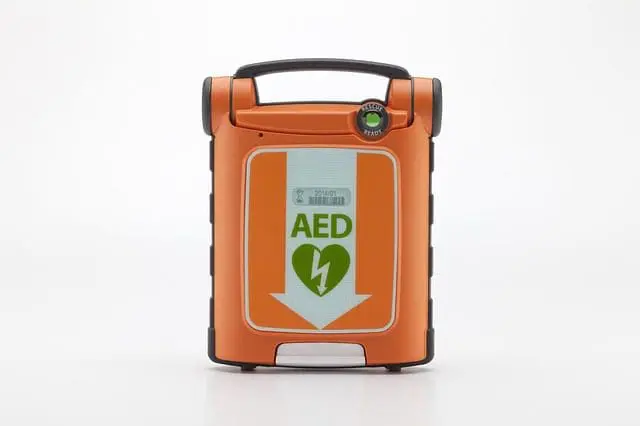
Automated external defibrillators (AED) are an important lifesaving technology and have a role in treating workplace cardiac arrest. Most sudden cardiac deaths occur outside of the hospital and statistically 5% of all Sudden Cardiac Arrests (SCA’s) will occur in the workplace. That amounts to 100 people every week in the UK alone!
At the moment there is no current legal requirement for an employer to provide a defibrillator in the office. However, if defibrillation is delivered within the first few minutes after a cardiac arrest, survival rates can be as high as 74%. It’s common sense to have an AED in every workplace.
Why not just rely on the ambulance service?
- Time is critical when responding to a cardiac arrest.
- Emergency Services target response time 8 mins, 75% of the time
- Average Emergency Services response in Scotland 7.4 minutes and in England its 12 mins!
- Patients with life-threatening conditions – like cardiac arrests – are meant to be reached in eight minutes.
- Only one of the UK’s 13 ambulance trusts is currently meeting its target.
Reasons to have an onsite AED?
- On site AEDs save precious treatment time, and can improve survival odds because they can be used before emergency service personnel arrive.
- The AED is compact, lightweight, portable, battery operated, safe, and easy to use.
- Modern AEDs won’t allow you to shock a victim that has a heartbeat, reducing the risk of doing more harm and reasons for people not to step in and help.
- These devices have a proven track record of helping to save lives in public places as well as in the workplace.
- Placing automated external defibrillators (AEDs) in the workplace, along with proper management and training for employees, can mean the difference between life and death.
- Of the sudden cardiac arrest deaths that occur each year, more than 95 percent of the victims die before they reach the hospital.
- When care is provided within five to seven minutes (before an ambulance crew can get to the scene), including early treatment with an AED, survival rates can improve dramatically.
Can you afford to be without one?
Most objections to purchasing an AED seem to be financial.
Just like a sprinkler system in a building or a fire extinguisher, the defibrillator provides extreme value in a critical moment. Consider the key employees in your organisation – how many are over the age of 45? Would your company be impacted if any one of them died tomorrow at work? How much time and money would be spent in locating a replacement? Would productivity be affected by the loss a critical teammate? How will management be perceived by deciding not to invest in a device that costs less than a laptop computer, a device that could have saved an employee’s life?
Unfortunately, many purchasers of AED’s have already had a workplace event that moves them to see the need and value in having these units available. It is human nature to base our assessment of value and risk on our experience. If your workplace has never had a cardiac arrest event, the perception may be that the unit may not be used or needed. Unfortunately, this method of risk assessment is flawed.
Oh, and remember that person have a cardiac arrest, it could be you!
Want to learn how to use an AED or perform CPR?
We now offer a dedicated short course – learn how to use an AED in just 3 hours.
This Basic Life Support (BLS) & Defibrillator (AED) training courses is designed for organisations who have bought an AED and wish to train staff on its use.
Also check out our video below: