Summary
Medi-K First Aid Training Equestrian Sector Liaison for England Jo Maidment travelled to the very first BETA Safety Equipment Conference held in Loughborough in April and joined delegates from all sectors of the equestrian world. She summarises her visit and the most important and interesting facts and statistics learned about equestrian safety and their first aid implications.
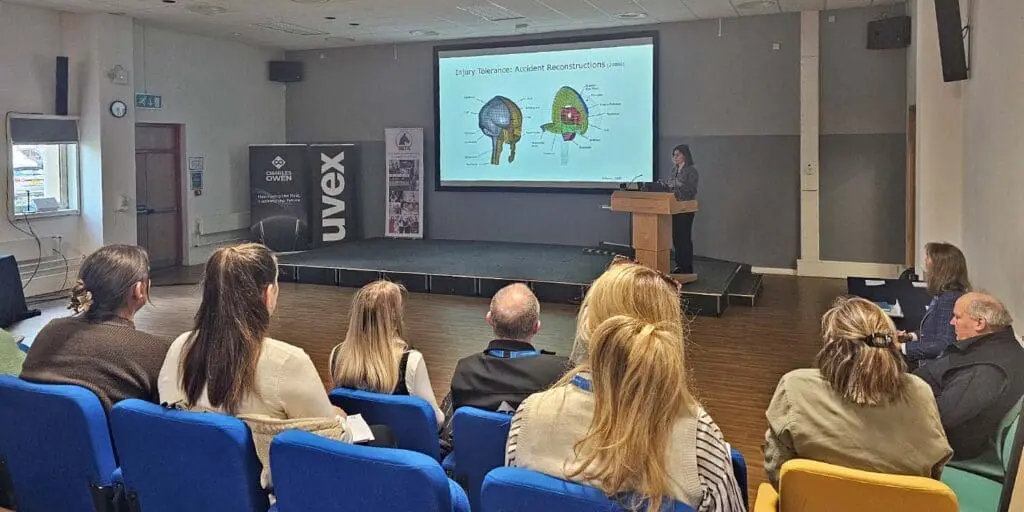
Did you know that Medi-K (a subsidiary of First Aid Training Cooperative) are member of the British Equestrian Trade Association (BETA)? Last month (April 2026) I was lucky enough to attend their very first BETA Safety Equipment Conference, held at Loughborough, and spent the day with some top professionals in the equestrian safety field. The theme of the day was to look at Equestrian Safety particularly in respect of riding hats and body protection.
The speakers presenting at the conference were some of the leading researchers, developers, manufacturers and riders, including; –
- Claire Williams, BETA.
- Dr Stephanie Bonin, PhD, MEA Forensic Engineers & Scientists – The state of research into rider safety equipment – Past, Present and Future.
- Daloni Lucas Analysis and prevention of spinal injuries in horse racing.
- Robin Spicer, Lemieux Ltd Designing Safer Helmets: Understanding Rotational Protection.
- Lorna Cameron Senior Lecturer, Department of Equine Sciences, Hartpury University Safety Versus Comfort: A Preliminary investigation into the impact of body protectors on comfort, rider position and considerations for female riders.
- Megan Barnes-Wood, KTP Associate, Champion Mfg Understanding Repetitive Head Loading: Sub-concussive impacts in football and their relevance to equestrian head protection.
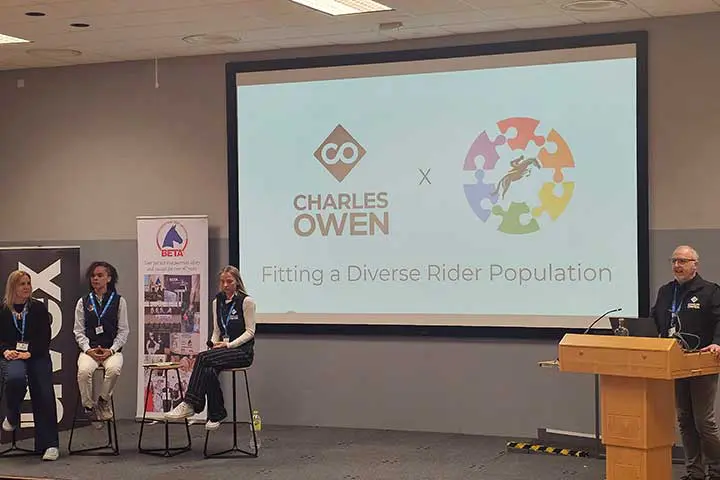
- Jade Faulkner, Dave Derby, Charles Owen, Lydia Heywood and Jayda Everett from Cool Ridings, Kathryn Jaquet, RB Equestrian Fitting a diverse rider population.
- Claire Williams, BETA “Safety” Stirrups- attitudes toward and the need for standards.
- Dr. Mark Hart, CMO, FEI Rider attitude to safety and the FEI’s position & approach to rider safety now and in the future.
- Laura Collett, MBE, European Champion, Gold medal winner at Paris and Tokyo, courtesy of Zebra Products, distributor of Uvex. An eventer’s perspective on safety.
Safety First
This conference was not only of interest to me as a first aid trainer working within the equestrian sector, but also as a leisure rider, who in 2019 had a potentially life-changing accident while jumping my horse with a friend. Unfortunately, our lovely day ended abruptly when my horse stumbled after a fence and threw me over his neck and through his ears resulting me landing on my head followed by the rest of my body, resulting in compression fractures of my T5 and T6 vertebra. My consultant confirmed that my injuries were not more severe due to me wearing certified and approved safety equipment, my hat and body protector. Now I am the first to admit having grown up with horses in the 80’s and 90’s, my attitude to safety products was lax to say the least. I only rode wearing a hat when in lessons but often rode ponies down the lanes to the fields bareback, just a head collar and lead rope and NO hat. I definitely had the ‘it won’t happen to me ’ syndrome. It was only the eventers who had body protectors and all the gear, not us yard girls.
However, after having a significant break from horses and returning in my late 30’s early 40’s, my attitude had changed a considerable amount. No more riding without a hat and I found myself purchasing a body protector for ‘normal’ riding. Interestingly, research shows that riders attitudes to safety products has significantly shifted since Covid, and Safety products are now one of the best selling categories. So why did I only wear my body protector occasionally? Well I found the body protector to be ill fitting, uncomfortable and restrictive to ride in, so didn’t wear it as often as I should have. However, after listening to the research from Lorna Cameron at Hartpury College, I obviously wasn’t alone in feeling this.
Equestrian Safety Survey
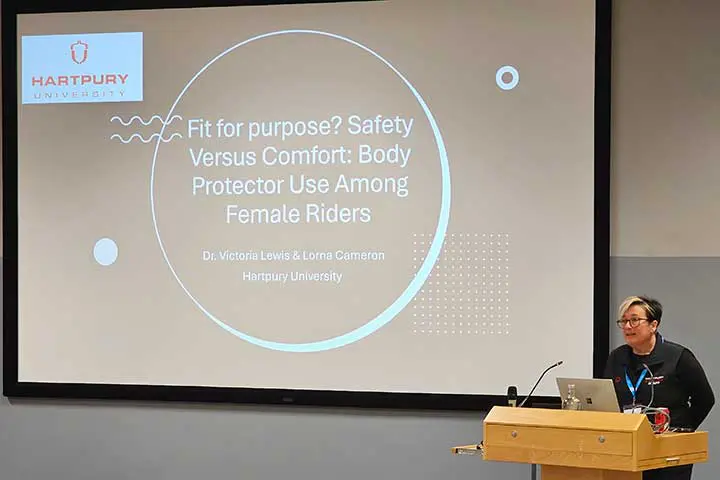
In 2024 Lorna ran a study by sending a survey out to the equestrian community looking at safety versus comfort with body protectors and received 3,757 responses. 95% of respondents had fallen within the last 12 months and 17.9% had fallen more than 3 times in the past 12 months. 97% of the respondents were female. The most common activities where these falls occurred were Hacking = 25.9%, Flat schooling = 25.8%, and Jumping Schooling = 19.4%. Now as a happy hacker this surprised me as I would have expected Eventing or Cross Country to have been in the top 3, but this sector has actually seen a significant fall in the severity of injuries and less reported injuries, since the wearing of body protectors has been made mandatory. The most common injuries were to the back and shoulder. Interestingly on 8-14% of riders injured were wearing body protectors at the time of their fall. So why are so many riders, particularly female riders not wearing body protectors, Lorna has done a further study looking at safety v’s style which had 1010 riders respond, 97% female and 89.5% classing themselves as amateur riders, and the key findings from this showed that compared to professionals, amateurs have a higher level of consistency in wearing their body protectors every time they ride, whereas professionals tended to only wear them when competing.
So why are people not consistently wearing body protectors? Due to the under representation of male riders in respondents, the findings found that the main reasons for females not consistently wearing them came down to Comfort, Fit – especially for the larger busted rider, many felt it restricted their natural movement when riding and altered their position and caused stiffness and rigidity in the saddle. Lorna is now looking at other physically demanding professions which require females to wear body armour protection and hopefully working with manufacturers to design more female friendly fitting body protectors. Lorna is always looking for volunteers to join the study at Hartpury College.
Riding Hats – Concussions and Brain Injuries
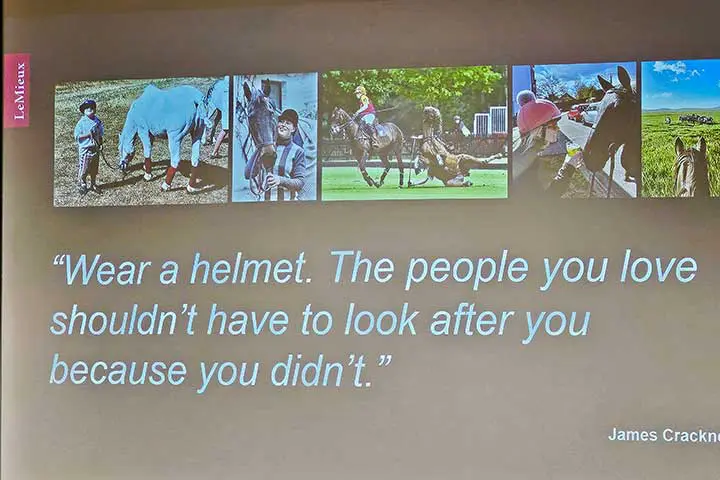
Now I won’t be the only rider to have suffered from concussion after a fall, and its safe to say that most of us riders, dismiss a bang to head as just a minor thing that is all part of riding, Well that’s why we wear hats isn’t it? However, did you know that effects from repetitive loading of sub concussive injuries put equestrians in the same category as Rugby, Football and Boxing? Most of the injuries to the brain are either rotational or linear, with rotational injuries causing the biggest damage to the brain due to the lag of the brain tissue moving out of time from the skull, therefore increasing the risk of the rider sustaining a traumatic brain injury.
Certified and approved riding hats have a wide range of different technologies to help reduce the movement of the brain as much as possible either through the MIPS system etc. by reducing linear and some rotational force on impact. But what is more important than wearing the correctly fitted and certified hat, is replacing it after ANY fall or knock to it even if there was no injury, as they are designed to absorb the impact and this means that its integrity is now compromised. I for one was guilty of not wanting to replace my hat after what I felt was an insignificant knock in the past, and with the associated costs of the equestrian sector this can be a major barrier to ensuring our hats are safe. Did you know that your hat has a life span and should be changed around every 3-5yrs even if you haven’t had a fall or knock? So how old is your current hat? Will it still protect you? There is some good news here though – did you know BETA will buy your damaged helmet and body protector off you for around about £100, so that they can investigate the impact of your fall had on the safety equipment, now surely that’s got to be an incentive to change that hat post accident!
Jockey Injuries and Body Protectors
Now I am sure you are all aware that the Racing world is often in the news, and having just had the Grand National and Cheltenham Festival, the same arguments and discussions are back in news over safety concerns for Riders and Horses. During the conference we were presented with some research from the racing sector regarding Jockey safety, where statistics showed that flat jockeys had a fall rate of 1 in every 250 rides = 35% of those suffered an injury whereas, Jump jockeys have a fall rate of 1 in every 20 rides = 20% of those suffered an injury. 27% of those injuries were to the head and neck. The research looked at the types of spinal injuries suffered by jockeys, 18% (44 fractures) were to the Cervical Spine (Neck), 64.5% (158 fractures) were to the Thoracic Spine due to its rigid structure, and 17.6% (43 fractures) were to the lumbar region. They did note that there seems to be an underreporting of concussions within the sector, however 87% had a head injury from a fall.
One thing that did come out of the survey was the inconsistency and poor compliance around jockeys wearing body protectors, and even within those that did wear one, it was observed that many jockeys had made their own adaptions to them to improve fit and comfort and helmets were prioritised over purchasing body protectors. Finding from this research has now led to future research into Jockeys having mandatory fitting of a body protector, Inspections of all helmets and body protectors post fall, clarification over the life span of a body protector, more mobility supportive designs, investigation into the interaction of helmets and body protectors when in the racing position, fall training for all jockeys, physical conditioning, and equipment implementation. However, a lot of this research will help the other equestrian sectors in supporting everyone from leisure rider to the professionals.
Ethnic Safety Considerations
Interestingly there was also a discussion around the challenges faced by people from different cultures especially those from the African-Caribbean community who due to the differences with their hair and hairstyle struggle to get hats to fit them properly.
Safety Standards – The Need for Certification
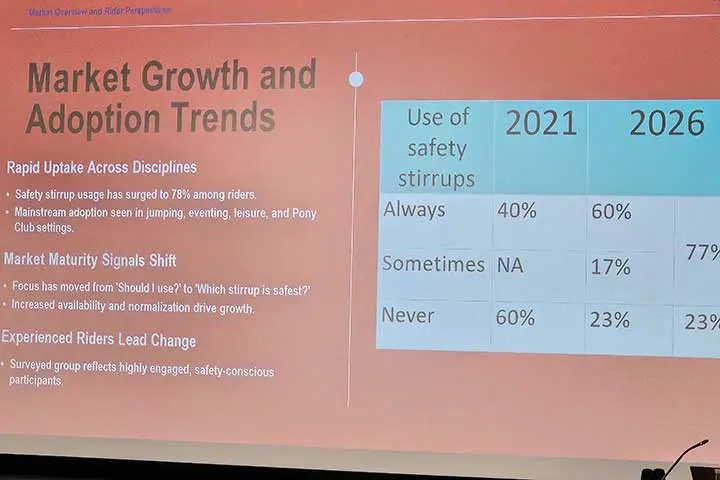
The other area of safety equipment that was discussed was the rise of the ‘Safety’ Stirrup, and just how safe are they? Surprisingly did you know that there are no agreed safety standards for equipment for horses, which includes stirrups? This was a major shock to me, so we are reliant on brand marketing rather than official safety standards when purchasing protective equipment for our beloved horses. When asked especially about safety stirrups, there is a lot of confusion in the equestrian community around how safe are they and do we need them. Most of the respondents thought that safety stirrups offered protection from your foot being stuck in the stirrup and the rider being dragged along and there was no clear trusted brand identified plus a distinct lack of trust and clarity on how they work.
However, what is clear is that there is an urgent need for some development of certified safety marks and standards for all horse wear, but especially stirrups, more independent research into the safety aspects of stirrups, and for stirrups to be considered as PPE like Body protectors and hats are, as they aren’t currently. Unsurprisingly, our sport is considered high-risk and quite unique in the fact that we are partnered with +/- 500kg unpredictable animal. So it’s no shock that it’s the leading cause in ER/A&E emergencies. However, the good news is that attitudes are changing in regard to personal safety and using the products that are available for everyday riding.
Improvements in Eventing
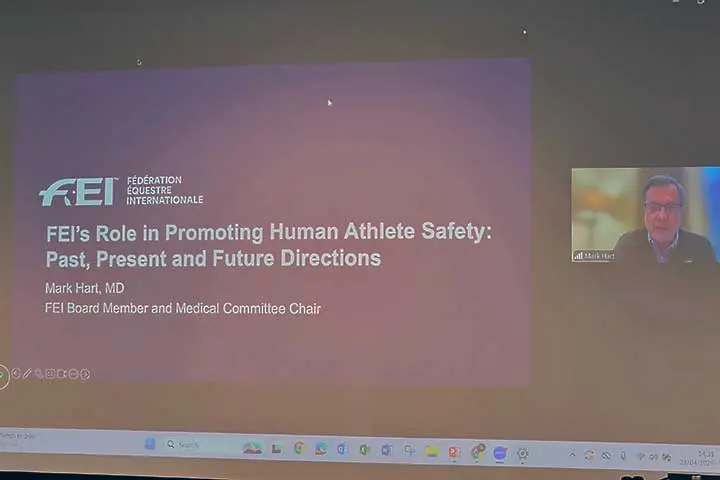
One particular discipline to notice major changes around safety is the eventing world, after the release of the Hartington Report 2000, safety was the top priority for the FEI and British Eventing. The main changes were the implementation of changes to course design and building (the introduction of the frangible fence technology so fences collapse), work on preventing rotational falls, and the introduction of the mandatory wearing of body protectors for all competitors at all levels, as well as minimum standards to meet for eligibility to compete at the different levels. After these changes were implemented, Eventing saw a >50% reduction of serious rider injuries in the last 10 years and 71% reduction in rotational falls, it has also helped improvements in equestrian specific PPE.
The Future of Equestrian Safety
Change in the equestrian world is a slow process as a lot of the sport in heavily entwined in tradition and history, and it took until 2013 for the FEI to mandate the wearing of hats in ALL equine disciplines except Vaulting. So what is on the to-do list for the FEI going forward regarding safety?
1) Development of international standards for certificated organisations.
2) More research funding to work with manufacturers to comply with the standards, while ensuring the equipment is both safe and affordable.
3) Agreed testing standards for all PPE, as, as it currently stands every manufacturer uses a different criterion for testing. But ultimately improve the education around safety in our sport for all stakeholders.
Leading by Example at the BETA Safety Equipment Conference
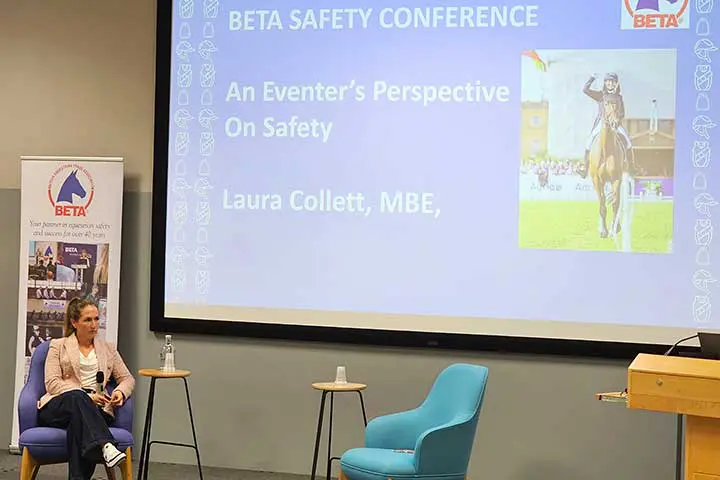
It was also great to hear from Laura Collett, MBE, and her attitude towards safety products, and that she wears her PPE whether competing or training as both carry the same risks, although some people don’t share that opinion.
Choose Medi-K for your First Aid and Mental Health First Aid Training
Here at Medi-K we are passionate about raising the safety standard within the equestrian community by providing you with the first aid skills required if the worst was to happen, so please have a browse of our equestrian first aid courses page and then contact us if you would like to discuss further what our equestrian courses entail and how to book today!