

Injuries during sporting activities are common but they are avoidable. Follow this regularly updated guide (last updated March 2025) to prevent the most common golfing injuries.
A lot of golf injuries occur as a result of repetitive movements or the lack of a warm up. You’d never see a professional golfer walk straight out to the first tee without a warm up session beforehand. Warming up your muscle groups helps prevent injuries but also helps activate your muscle memory and play better! (Warming up also gives you a chance to perfect that swing before the first tee!)
Warm up to prevent or minimise golf injuries!
It’s obvious from the injuries listed above that a good warm up is essential for you golfing health. Don’t be embarrassed doing this in your own club – think of all those top professionals who warm up before hand – copy them and channel their energy. Golf uses so many muscle groups, they’re all at risk if they’re expected to perform when cold. Hitting balls is not always the best way to loosen up those tight muscles. This video from Mike Malaska takes you through a thorough pre-round warm up.
Exercises to keep you strong and supple are good for your whole life health, not just golf, so why not get into a regular routine at home too?
Longer term good practice for golfers:
Although golf is widely classified as a low impact sport, poor form and a lack of stretching can lead to injury and these may become chronic. If you have a persistent pain or injury, speak to your GP or physiotherapist. In fact, if you have a coach or golf professional you can speak to, they may well spot a point in your swing that is causing you the pain.
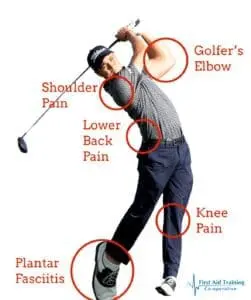
The five most common golf injuries are:
- Low Back Pain
- Golfer’s Elbow
- Plantar Fasciitis
- Knee Pain
- Shoulder Pain
1. How to prevent lower Back Pain when playing golf
The repetitive action of the golf swing is the number one cause of low back pain in golfers, so golf swing faults should be corrected by a professional. A ‘Reverse Angle’ swing fault is a common cause of back pain that occurs when the spine deviates from the vertical during the swing.
But what can you do to prevent Low Back Pain? Research has shown that specific back exercises, known as core strength and stability exercises, can be effective in the prevention of low back pain. These include exercises such as sit-ups, side bends and ‘the plank’.
2. How to prevent Golfer’s Elbow
Golfer’s elbow is inflammation of the tendons of the forearm at the point where they insert into the humerus (upper arm) bone. This inflammation is caused by forceful gripping activities such as when gripping the golf club. Typically the pain is made worse by gripping activities and in some cases, simple things like picking up a bag can cause intense pain.
Gripping the golf club too hard can bring on the Golfer’s Elbow pain. If you play golf for the first time in a long while making sure that you regularly stretch the muscles which work over the wrist by doing ‘limp-wrist’ and ‘policeman halting traffic’ type stretches. Some helpful hand and wrist exercises are linked here.
3. Plantar Fasciitis and how to prevent it
This is inflammation of the Plantar fascia (a fibrous sheath under the sole of the foot), at its attachment to the heel bone. It is a common cause of heel pain in golfers that typically comes on when walking around the golf course. Plantar Fasciitis is particularly prevalent in those golfers with poorly fitting footwear.
Inappropriate footwear plays a major role in the development of Plantar Fasciitis. Golf shoes that have a lack of support for the sole of the foot are the biggest cause. Research has shown that orthotic insoles that support the arch on the inner side of the foot can be helpful. Your feet change with your age and body size so don’t assume the good old golf shoes you’ve had for years are still the right fit for your feet.
You can also try stretching and strengthening your muscles. To do this, following this simple routine:
- While sitting, place a towel on the floor. Use your toes to pull the towel towards you. Hold the squeeze for 30 seconds, or less if uncomfortable.
- Continue sitting and grasp your toes, gently pulling them towards you until you feel a slight stretch in the arch of your foot. Hold the squeeze for 30 seconds, or less if uncomfortable.
- From a standing position, lean face-forward with both hands against a wall. Stretch your back leg straight and bend your front leg, keeping both heels on the floor. Move your hips slowly forward until you feel a stretch in your calf. Hold the stretch for 30 seconds and do not ‘bounce’. Switch legs to complete the exercise.
- Return to step 1 and repeat.
4. Preventing knee pain as a result of golf
During your golf swing, your knees are under rotational and movement pressure. Often, the knee pain is not initially caused by golf, but an existing condition is aggravated by the golf swing movement, causing knee swelling and pain.
But what can you do to prevent knee pain? Pain in the knee joint can lead to weakness of the Quadriceps (thigh) muscles. This leads to a vicious circle of further knee joint instability and more pain, leading to more inhibition and muscle weakness. Exercises to maintain Quadriceps are encouraged to provide support for the affected joint. Strong healthy quads support your knee and can help prevent any ligament or tendon injury.
To stretch quadriceps:
- Take a standing position and find a stable surface to lean on
- Bend back one knee by grasping your ankle with one hand
- Bend your knee back as far as is comfortable
- Maintain the position for 30 seconds
- Return to standing and repeat for the other leg
- Repeat 3-5 times for each leg.
5. Shoulder pain from golf?
The ‘Rotator Cuff’ muscles can become damaged during the repeated stresses of the golf swing, particularly if there is a swing fault such as ‘Chicken Winging’ (bent elbows at ball contact) or a ‘C-Shaped Posture’ (rounded lower back) that can put too much stress on the shoulders.
Shoulder pain is always a complicated and often a long term injury, but we recommend preventing this by maintaining flexibility, strength and endurance of the shoulder muscles with regular exercise. the NHS has some excellent videos on shoulder exercises – watch their Various stretches and exercises are available here.
First Aid Responsibilities of Golf Clubs
Do you know about your Duty of Care towards your members and players?
Definition of Duty of Care: In essence, a duty of care means that a sports business needs to take such measures as are reasonable in the circumstances to ensure that individuals will be safe to participate in an activity to which they are invited.
There is no general duty of care upon members of the public towards the public at large. If there is a formal relationship, however, for example between a club and a club member, or a coach and an athlete, there is a duty of care.
When children and young people are involved in organised sports activities and are to any extent under the care and/or control of one or more adults, the adult(s) have a duty to take reasonable care to ensure their safety and welfare.
Legal Duty of Care: In many sports activities, it is recognised that a sports business or individual (e.g. coach) owes a duty of care to its members. However, it is also understood and recognised that accidents can and do happen, and that it is not possible to predict every eventuality. Liability for the legal duty of care would only arise when an incident occurs and it can be demonstrated that the risk was foreseeable but no action had been taken to remedy it.
Where there is public access to the club grounds through public footpaths etc, there is also a duty of care to those using these paths. Under Scottish law, this applies to all golf courses.


We can deliver a golf specific first aid course at your venue, no matter how large or small, from St. Andrews to the Isle of Seil!
We offer First Aid Courses for Golf, approved and promoted by Scottish Golf
- Our golf first aid courses have been developed and supported by Scottish Golf.
- Our courses are tailored to the needs of clubhouse staff, greenkeepers, team captains, coaches and course professionals.
- The courses focus in on specific golf related injuries and risks and help you gain understanding and confidence should you need to deal with an incident on the course or driving range.
- We have trained over 13000 students in first aid and 95% of them rate us as ‘very good’ or ‘excellent’.
Find out more about our Golf First Aid courses.