Updated October, 2023.
In the video link below, we show you how to perform CPR and use an Automated External Defibrillator (AED) on an adult casualty you suspect has suffered a cardiac arrest.
If a casualty is unresponsive, AND is NOT breathing effectively, the statistical likelihood is that they have suffered a Cardiac Arrest, i.e. their heart has stopped.
Over 30,000 people suffer an ‘Out of Hospital Cardiac Arrest’ every year in the U.K. Every minute without CPR and defibrillation reduces the chances of survival so swift and confident action is crucial. Performing CPR and using an AED can more than double the chances of survival.
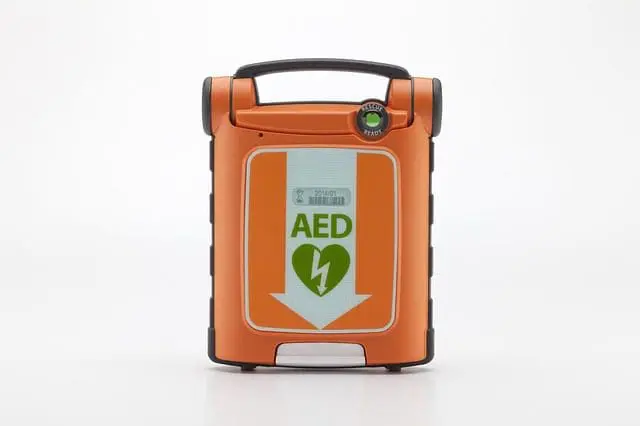
A defibrillator in a public place is usually mounted on the outside of the building or inside if it’s a business. Most supermarkets have them inside. They are marked with a large green and white sign.

Watch our video of CPR being performed with an AED in use:
Some important things to note:
- Shouting for help and getting someone else to go an get the defibrillator as well as making that phone call really helps you, the first aider, as you can start CPR straight away.
- Knowing where your nearest defibrillator is located will greatly improve their chances of survival. Get to know your local defibrillator locations – before you need them.
How to do CPR, step-by-step:
- A – Assess for danger – When you come across a casualty, stop and assess for danger. Do not put yourself at risk. Remove or minimise the danger e.g. traffic, horses, mountain bikers on the trail etc.
- When the scene is safe, put your first aid/ surgical gloves on if you have them with you and approach the casualty.
- A – Are they alert? – Call out to them ” Hello may name is _________. I’m a first aider / here to help. Can you hear me?”
- Tell them, in good voice, “Open your eyes. I’m going to put my hands on your shoulders. Open you eyes if you can feel that”
- Shout for help! If there is no response – shout for help, loudly.
- A – Check their airway – Open the casualty’s airway by tilting back their head slightly and lifting their chin.
- B – Check they’re breathing – Look down to their chest or belly and see if they are breathing. Count for 10 seconds. If they’re not breathing effectively…..
- NOW PHONE 999/112 and tell them your location and that you have an unresponsive, non-breathing casualty and that your are going to start CPR. The switchboard may tell you where the nearest defibrillator is.
- If someone has come as a response to your help shout, get them to make the phone call and/or go to get the defibrillator.
- Starting CPR:
- Interlock your fingers, one hand above the other. Using the heel of your hand, place your hands in the centre of the casualty’s chest.
- Keep your arms straight and your shoulders in line above your hands.
- Do 30 chest compressions, 5-6 centimetres deep into the chest.
- Count out loud 1-30 at a rate of about 2 per second. (or think of the rhythm of the Bee Gees song ‘Ah Ah Ah Ah Stayin Alive, Stayin Alive…’ or ‘Nellie the Elephant’ as a guide to the rate of compressions. Don’t sing these out loud though!)
- After 30 compressions, do 2 good rescue breaths using a face shield if available. Look down to their chest after each breath to see if their chest is rising.
- Then return to do 30 more chest compressions.
- Continue doing 30 chest compressions followed by 2 rescue breaths until the AED arrives……..
How to use a defibrillator (AED), step-by-step:
- When the AED is being set up by someone else, DO NOT stop doing CPR. It’s easy to get distracted when you’re telling them what to do or how to set it up;
- Turn the defibrillator on by pressing the large green button. You may need to hold it down for a second or two;
- Once you turn the defibrillator on, it talks to you and takes your through step by step;
- It will say “Attach pads to patient’s bare chest”. Place the sticky pads on the casualty’s top right side of the chest and lower left side of the rib cage areas – as per the pictures on the pads. The pads have sticky backs which need to be removed before attaching. (The bare chest can be wiped dry or shaved where required – there is usually a razor and towel in the AED bag/box. Bras do not need to be removed or cut)
- It will then say ” Plug in connector next to flashing light”. These are usually yellow like the plug connector at the end of the sticky pad leads .
- It will then say “Analysing heart rhythm – do not touch the patient“. Stop doing CPR at this point so the defibrillator can analyse the patient’s heart rhythm without you doing chest compressions on them.
- After analysing, it may say “Shock advised…… Charging………..Stay clear of patient……Do not touch the patient…..Deliver shock now…press the orange button now.” Press the orange button with the electrical symbol on it.
- After shock is applied, it will usually say “Begin CPR” and it will emit a bleeping sound which is the correct rhythm for doing chest compressions.
- After analysing, it may alternatively say “Shock not advised. If required, begin CPR“. This does not mean the patient is improving or that their heart has started again. It means the rhythm it detected would not benefit from a shock.
- Every 2 minutes the defibrillator will go through this sequence again to re-analyse the heart rhythm.
- Keep doing CPR at a rate of 30 chest compressions to 2 rescue breaths AND follow the instructions from the defibrillator until the ambulance arrives and the paramedics tell you to stop.
At some stage, you may want to share the workload of doing CPR as it can be very physically tiring. It is an easy technique to show someone. If someone helps you, give them tips on their technique and lots of praise for stepping in to help.
Using a defibrillator is an essential skill in first aid these days. It is now part of the standard syllabus for all first aid courses.
If a defibrillator is available – use it. It is a life saver!

Frequently asked questions:
How easy is it to use a Defibrillator?
Defibrillators are automated devices that talk you through, step-by-step on how to use them. There are 2 buttons – a green one to turn it on and off and and orange one to deliver a shock to the casualty when instructed. They have sticky pads with leads attached. You put the pads onto the casualty and then plug the leads into the defibrillator. Sometimes there’s slider type button so you can select adult or child.
Can I kill someone with a defibrillator?
No. The defibrillator analyses the heart rhythm of the casualty and only advises you to press the shock button if the casualty would benefit from the shock. There are many different heart rhythms. Defibrillators are designed to only deliver the shock where necessary.
The defibrillator says “no shock advised”. Does this mean the casualty is getting better or their heart has started again?
No, it means the rhythm that the defibrillator is detecting has changed. It will always ask you to continue CPR if required.
How can I find my nearest defibrillator?
- In an emergency, phone 999/112 and they will tell you where your nearest defibrillator is
- Online site = Defibfinder www.defibfinder.uk This is map based website showing defibrillators that are available and the hours you can access them. Some are inside buildings that are only open during business or school hours.
- Register a defibrillator on the The Circuit. www.thecircuit.uk This is the national register of defibrillators in the UK and is the database that emergency services use. All defibrillator owners are encouraged to register their defibrillators onto this site. Once registered, the defibrillator will automatically appear on the www.defibfinder.uk website. If you know of one locally, ask if they’ve registered it with The Circuit. It could save a life in your community one day!
Is funding available for a defibrillator?
Yes, several charities offer part funding for defibrillators. You can read more about what makes up a defibrillator station and where to seek funding in our Funding a Defibrillator blog here.
Get confident – get some first aid training
We use and practice using defibrillators in all of our First Aid courses. Our systematic approach to teaching first aid helps your learning and understanding of many illnesses and injuries. Practicing first aid techniques reinforces your learning too. Find our more about our full range of First Aid Courses here.
Every client on our courses receives a FREE Digital First Aid Manual relevant to the course they come on. You can also view and buy our manuals in our online shop. In addition, we have our own YouTube channel with over 40 practical first aid videos.
We also offer an AED Defibrillator short course designed for companies, communities or individuals who wish to take the initiative and get an Automated External Defibrillator (AED) on their premises or in their community. This allows organisations to demonstrate best practice, and give all members of staff the confidence and competence to use a defibrillator if they have to.