
Updated March, 2026
Everything you need to know about ticks, tick removal, and Lyme Disease.
Why should we be concerned about ticks?
Ticks are small arachnids that feed on the blood of birds and mammals, including humans. They may carry a range of pathogens (bacteria, viruses, protozoans etc) that are then transmitted to the host when they bite. It is therefore important to remove an attached tick as soon as possible to avoid contracting these diseases. It is also important to remove the whole tick on one piece to avoid any pathogen being disgorged into your bloodstream during removal.
Ticks may be carriers of bacterial, viral or other pathogens that they have picked up from other hosts, i.e local wildlife. When they bite into you, they regurgitate their stomach contents whilst feeding. If they have picked up a pathogen, they will infect your blood with it whilst attached. It is therefore very important to get the tick removed as soon as spotted. They may stay attached to you for up to 36 hours then they drop off you and go in search of another host to feed on.
Not all ticks are infectious. Recent estimates state that between 5% and 15% of a local population of ticks may be carrying Lyme Disease. This will vary year to year and location to location. It is difficult to accurately quantify these figures as not all human cases are reported. It’s best to be aware of the signs and symptoms and the risks involved in having an infected tick hitch-hike along with you on your outing!
Ticks are found throughout Europe, Asia, Australia and in America. The term Lyme Disease originated from the town of Old Lyme in Connecticut, USA, where there was an outbreak of arthritis linked back to ticks. Ticks in other countries may carry additional diseases and/or different variants compared to UK ticks.
How do you remove a tick safely?
Use a tick removal tool such as tick twisters, tick cards or fine point tweezers. You can watch this useful NHS Scotland video on how to remove ticks which includes a real tick removal example.
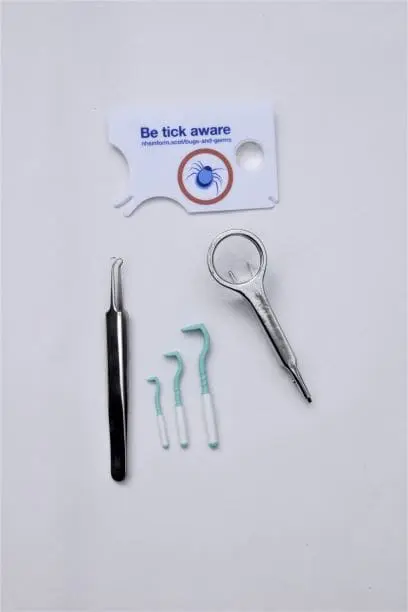
Using a tick twister to remove a tick:
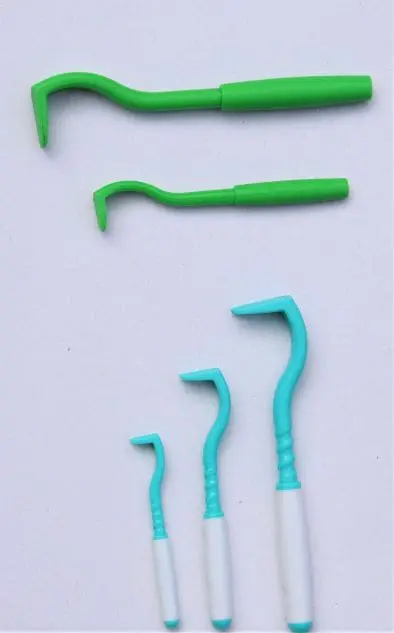
Tick Twisters are quick and easy to use. They work by forcing the tick to let go of you and are very successful at getting the whole tick off in one go.
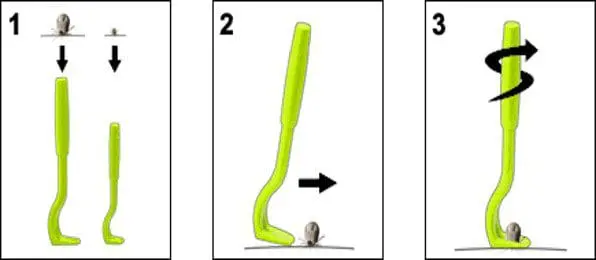
- Select the right size of Tick Twister for the tick
- Slide the Twister under the side of the tick
- Slowly twist / turn the tool and gently lift the tick off
Using a tick card to remove a tick:
Tick cards are easy to carry with you and have small and medium sized slots in them to ‘flick’ embedded tick off your skin.
- Lay the card flat on your skin alongside the tick
- Slide the appropriate size of card slot under the side of the tick
- Lever the card up to ‘flick’ the tick off, gently
- Don’t flick it too hard else it might just land on another part of your body or someone else!
Using fine point tweezers to remove a tick:
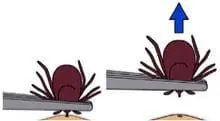
Tweezers can be a bit fiddly to use as they sometimes pinch the skin as well. Always use fine point tweezers. Don’t use domestic or utility tool tweezers with a broad point as they might decapitate the head and leave it in your skin. Squeezing the tick might also disgorge its stomach contents into you which may include the Lyme Disease bacteria.
- Grasp the tick with the tweezers where the mouth meets the skin
- Slowly and steadily pull the tick up and away from your skin
- Ensure you get the whole tick out, especially when using tweezers
After you’ve removed a tick, it is really important to:
- Put the tick on a hard surface and crush it using the end of the tick removal tool (unless you want to keep it for evidence or testing)
- Clean the wound area with a medi-wipe or soap and water
- Monitor the site for any rash that may appear
- Check the rest of your body for other ticks
- Clean the tick removal tool with a medi-wipe ready for future use
- Monitor your health and be alert to any other symptoms – see below for typical symptoms
A note on ‘traditional’ methods of tick removal!…..
Fingernails, alcohols, Vaseline, matches and cigarette ends are not effective methods of removing or killing a tick in situ. They only stress the tick into digging deeper, regurgitating more saliva and hence increase the potential for transmitting any infection.
What do ticks look like?

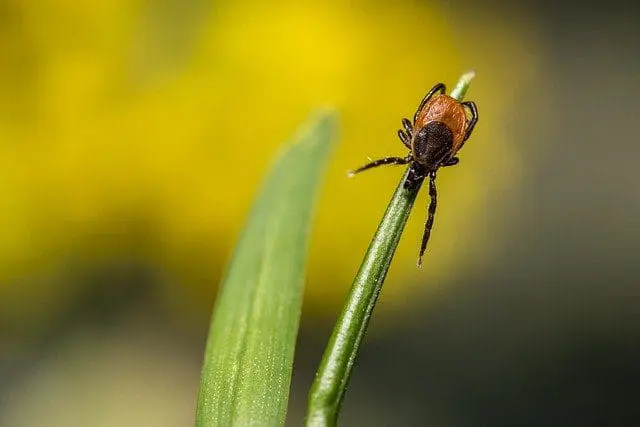
The ticks causing concern in the UK are mainly the species Ixodes ricinis and have a 5 staged life cycle. Moving from one phase to another is done after a blood meal from a host. Larvae are very small, have 6 legs and are least likely to be infectious. At the nymph stage, they have 8 legs, easier to spot, and are often called ‘questing nymphs’ as they roam around eager to find a blood meal. They are considered more likely to carry a pathogen. Adults are larger and the female is larger than the male. In the UK, their life cycle may take 2-3 years. As they feed on their host, their bodies bloat with the blood they have consumed.
Will I feel them bite me? (Ticks don’t tickle!)
Ticks inject an anti-coagulant into you which acts like an anaesthetic on your skin and helps them feed on your blood. You most likely won’t feel them during this process which is why it’s important to check yourself regularly when out and about. They are most active between spring and autumn but can be found throughout the year. They latch on to you from alighting from grasses, bushes and dropping on you from low tree branches. They move to a dark, moist place on your body and latch on with their mouths – in your armpits, stomach, groin, hairline, behind the ears or knees and between the toes.
What is Lyme Disease?
The most well known tick-borne disease is Lyme Disease and is caused by the bacteria Borrelia burgdorferi which is carried in the stomach of an infected tick. the bacteria doesn’t affect the tick. Lyme Disease can be a lifestyle-changing disease with some serious long term health implications if not detected and treated early. More and more people are diagnosed with the disease but many more may go undetected. In Scotland, there are now more than 500 cases diagnosed and over 2000 cases in England and Wales per year. These figures may not be the whole picture as many go undiagnosed.
What are the signs and symptoms of Lyme Disease?
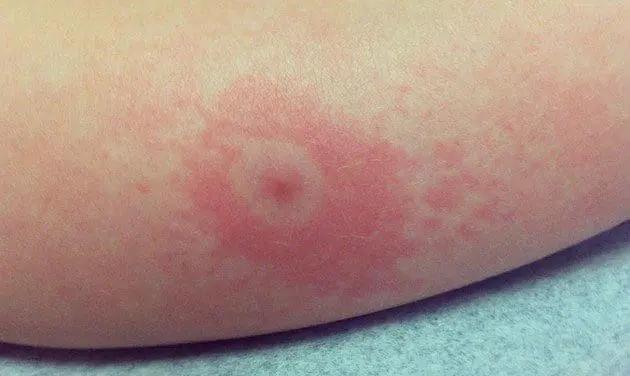
Early signs – after a tick bite, you may see a red rash where you have removed the tick. Rashes can also appear elsewhere, not just at the bite site. After a few days, the rash may develop into a ‘bulls-eye’ shape on the skin and is called Erythema migrans. This may appear between 2 – 40 days to first appear after the bite and it may grow over time. If you develop a rash, take a photo and mark the edge of the rash with a pen to monitor any change in size. Not all Lyme Disease rashes form into a bulls eye shape so don’t wait for it to do this! Go to your GP or Out of Hours clinic as a rash is a diagnostic sign of Lyme Disease and needs to be checked out by a medical professional. Antibiotics is the recommended treatment and 98% of people are fine after treatment.
Not all Lyme Disease infections present with a rash. Estimates of those who are infected and show a rash can range from 40-80%. That means a lot of infected people have no rash at all but they do have Lyme Disease.
Without immediate treatment or if that treatment is unsuccessful or delayed, further symptoms that may develop within 3 months (or longer – sometimes years) and include flu-like symptoms, facial palsy, muscle or joint pain and heart problems.
Longer term symptoms – Longer term symptoms may include chronic fatigue, neurological and arthritic problems. In the longer term, the infected persons immune system becomes over-worked and the patient feels very drained and exhausted. Neurotransmitters react to the disease by exhibiting heightened emotions, sensitivity to light and noise and light headedness when getting up or down.
If you have removed a tick and have any concerns about reddening of the skin or have any other symptoms, speak to your GP as soon as possible.
Is there a Vaccine for Lyme Disease?
In the video below, filmed at our First Aid Conference 2024. Liz Murray from the Lyme Resource Centre provides an update on Lyme disease recognition, treatment, testing, and the future of possible vaccines.
How is Lyme Disease treated?
If presented early, a treatment of the antibiotic Doxycycline will usually be prescribed and most people respond well to this with no further symptoms developing. Beyond this stage, or if attendance at your doctor is delayed, antibiotics and/or blood tests may be given or symptoms dealt with other appropriate treatments. Further treatment with other antibiotics sometimes follows the initial Doxycycline dosage.
Blood tests at an early stage are not always reliable as it detects the antibodies in your system and these take time to build up enough to be detected by the specific blood test. This is why early blood tests will often give a ‘false negative’ result. Blood tests later on in the progress of the disease are more reliable – but you don’t want to wait for that!
Persistent Lyme Disease
Lyme Disease is not new but is on the increase worldwide and a lot more research into it is ongoing especially into what is now termed ‘Persistent Lyme Disease’. The main focus of much of the research is into detecting the pathogens in different parts of the body. The 3 main symptoms of persistent Lyme disease are fatigue, neuro-cognitive difficulties and musculo-skeletal pain.
One of the challenges in studying the effects of Lyme Disease is the research in test tubes, mice or non-human primates is very difficult to detect and monitor the disease. The bacteria appears to behave differently in those hosts or settings.
Some studies have noted that the bacteria can enter a dormant phase and can grow again after antibiotic treatment. Boosting the immune response after antibiotic treatment may help and research into this is ongoing. Also, treatment with different combinations of antibiotics shows some promise in research. It is hoped that more targeted treatments in the future will result as a result of the world wide research programmes currently underway.
How can I reduce the risk of catching Lyme Disease?
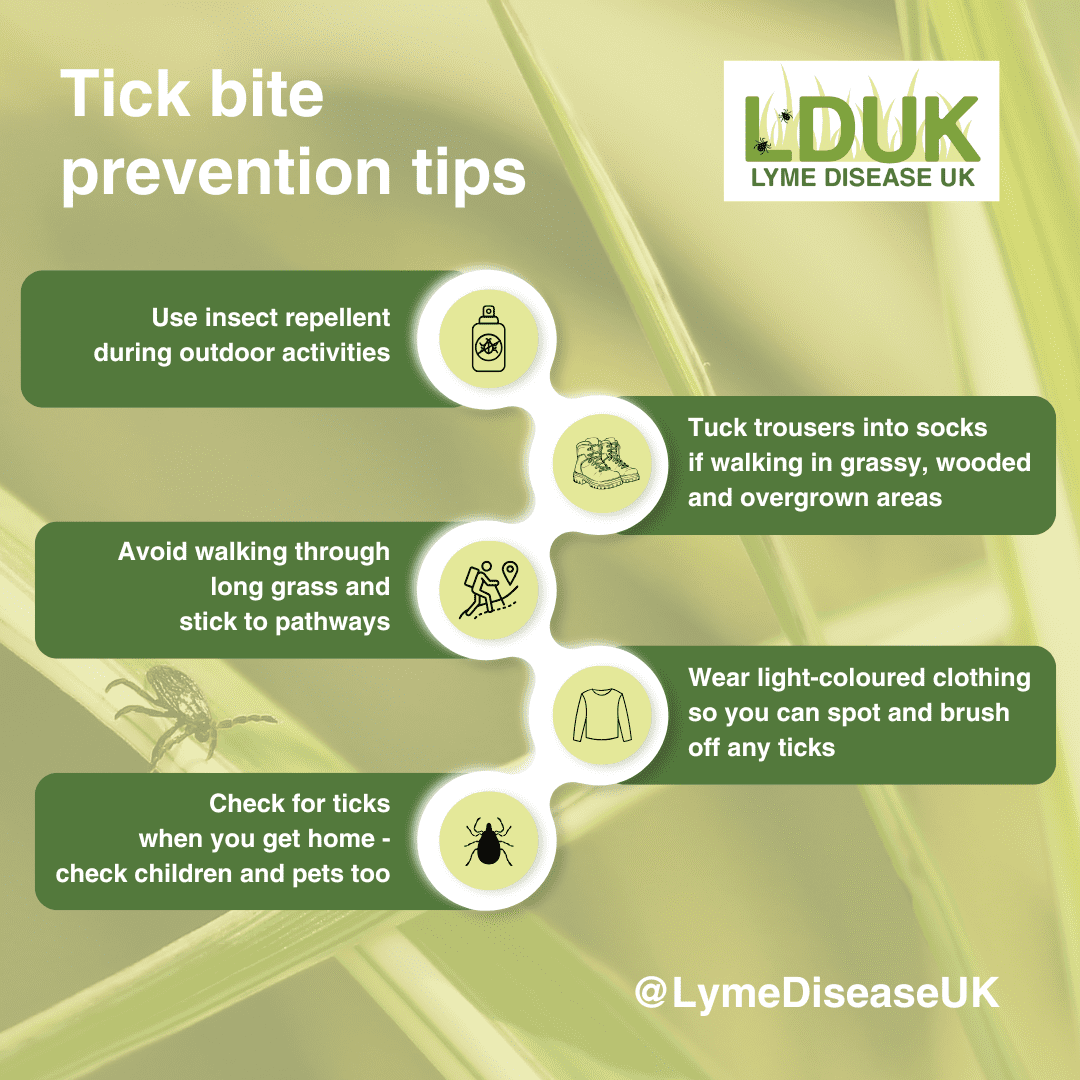
- Stay healthy – a strong healthy body is better equipped to fight off infection and recover from it;
- Be alert to the risk of ticks in an area and share this information with your walking group, friends and colleagues;
- Always have a tick removal tool handy whether you’re in the countryside or in the garden. Keep a set at home, in the car and at your workplace if appropriate;
- Keep to footpaths and avoid long grass and overhanging tree branches;
- Inspect yourself regularly whilst outdoors and when you get home. Have a buddy system in your group, family or workplace to inspect each other for ticks;
- Wear appropriate clothing in tick-infested areas – a long sleeved shirt, gaiters or trousers tucked into socks;
- Wear light coloured clothing as this may help you see ticks better. Ticks have also been seen in lab testing avoiding lighter colours;
- Use inspect repellent on your clothes and skin. Check repellents are suitable for children or pregnant women. You can also buy treatments that you wash into clothes that you regularly wear outdoors;
- Make sure you do not bring ticks home on your clothes or on your pets.

Tucking your trousers into socks gives the ticks less access to your skin!
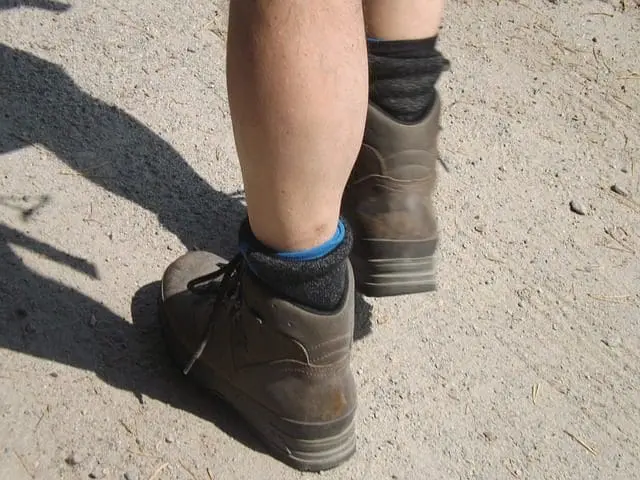
On hot days, be extra vigilant for ticks on your legs, they tend to climb upwards!
What other diseases do ticks carry?
Ticks carry other diseases based on the local pathogens they encounter in their many hosts. Although some of these are new to the UK, about 15% of the UK’s Lyme Disease cases come form people who have travelled overseas and picked up the disease there.
Tick-borne Encephalitis (TBE) is a viral infection now confirmed in England (2023) and Scotland (2025). This attacks the nervous system and can result in meningitis, brain inflammation and death. Patients who present early with first stage symptoms usually recover with the help of painkillers and anti-inflammatories. Patients who develop second stage symptoms require hospital treatment.
Tick-borne Babesiosis has also recently been diagnosed in patients in the south of England (2020). This is caused by a Babesia protozoan infection from the tick. The disease is rarely tested for by doctors and global levels are unknown. Several species of Babesia cause the disease and the signs and symptoms can be wide ranging. They include fever, fatigue, anaemia and nausea, symptoms that are common in many other illnesses.
Crimean-Congo Haemorragic Fever (CCHF). A viral infection that has no treatment and kills up to 40% of infected humans. This is a similar scale to Ebola or bubonic plague. Domestic animals such as sheep and cattle can maintain the CCHF virus at high levels and this means the potential for CCHF to expand into new regions like Europe is possible.
Sever Fever with Thrombocytopenia Syndrome (SFTS). Only identified in 2009, SFTS has sparked widespread concern throughout much of Asia. In Japan, 57 people have died of the disease since 2013. Signs of the disease can range in severity from relatively mild, such as fever and diarrhoea, to severe which can include organ failure. It is known to be carried by at least two tick species that are spread throughout the world including the UK.
Lyme Disease and Covid-19 – a comparison of symptoms:
With multiple symptoms, Lyme Disease and Covid-19 may cause some concern. This table, from Lyme Disease Action UK gives a quick check of the main early symptoms where “Yes” means fairly common but not in everyone. The darker red, the the most significant the symptom is in that disease.

Why are there more ticks around now?
Ticks can live in a wide range of habitats and were once mainly found in mountains and moorlands. With a combination of changes to our climate, increased number of people in the countryside, more wildlife in urban areas have all led to an increase in the ticks’ geographical range. Ticks can be killed off in a harsh winter but these are less frequent nowadays and therefore many of them live to breed throughout the year. There is also some evidence that in the UK and Ireland that tick numbers increase significantly in spring and early summer but are increasingly found throughout the year.
This article discusses the changes in tick numbers and climate change.
Can you test a tick to see if it’s carrying Lyme Disease?
Yes. Due to the variable results of testing humans for Lyme Disease in its early stages, many folk opt to send their tick away to get tested. The results are generally returned within a few days. Lyme Disease Test Kits are available in most outdoor shops and with a discount code via our website. Using these test kits contributes to our greater knowledge about the prevalence of infected ticks in the country. You can send 2 or 3 ticks in the test tube provided. One caveat though – you can test the ticks you find, but they may turn out to be the ones that are NOT carrying the disease. There may be others on your body or in the area that ARE infected that are not sent for testing. It’s good to check though, even to give you an indication of potential Lyme Disease in your local population.
Remember, the benefits of outdoor recreation far, far outweigh the risks – keeping active and healthy keeps your immune system in top condition in order to fight off any nasties!
Useful links about Lyme Disease and ticks:
- Discount on repellents and Lyme Disease test kits via our website
- The Lyme Resource Centre aims to educate the public and medical professionals about ticks and their diseases;
- Health Protection Scotland: Ticks and Lyme Disease in Scotland that includes information and data on Lyme Disease
- Lyme Disease UK website is run by healthcare advocates campaigning for more awareness and research into Lyme Disease.
- NHS video showing how to remove ticks with different tools:
- Forestry and Land Scotland – a series of videos from their ‘Ticked Off’ campaign:
Get confident – get trained!
We cover Lyme Disease and other environmental hazards on our range of first aid courses. Our systematic approach to teaching first aid helps your learning and understanding of many illnesses and injuries. Practicing first aid techniques reinforces your learning too. Find our more about our full range of First Aid Courses here.
Every client on our courses receives a FREE Digital First Aid Manual relevant to the course they come on. You can also view and buy our manuals in our online shop.