
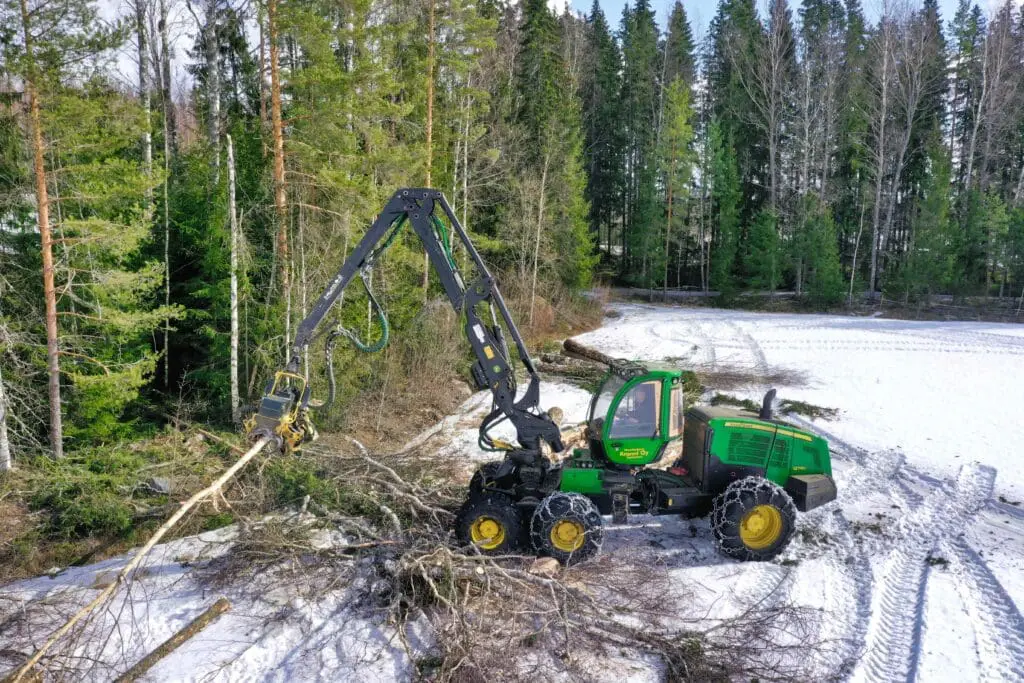
People working in forestry industries should attend forestry first aid training that includes additional topics relevant to the higher risks and remoteness of their work.
In addition, the Forestry Commission in England, Natural Resources Wales and Forestry and Land Scotland require contractors working on their land to have additional and specific elements in their first aid training. These courses use the abbreviation +F after the main course title. For example, “EFAW + F” for Emergency First Aid at Work plus Forestry.
What makes a +F Forestry First Aid course different to conventional First Aid?
Forestry operations – harvesting, transporting, mechanised ground preparation, planting, fencing, pesticides application, forest nursery activities or similar activities all tend to be high risk. Due to the remote location, if there is an incident first aiders tend to be looking after the casualty for longer periods of time than in a urban environment. In addition, some workers also work alone and therefore require to self rescue or know how to alert emergency services.
Most conventional first aid courses and emergency guidelines assume that people are working with a fairly immediate ambulance response times. Forestry environments have employees working in remote areas with limited or no communication along with challenging access for the ambulance service, meaning forestry first aiders often need to be able to look after casualties, and themselves, for a prolonged period of time.
The HSE has recognised the requirement for specialist Forestry First Aid training and are now recommending that all Forestry First Aid courses include training on trauma bandages such as Emergency Bandages, haemostatic clotting agents and the use of tourniquets. These are designed to deal with major bleeds and care for casualties for the longer periods required.
So, what are the different aspects to a +F course?…
1. Extra content is required for +F Forestry first aid courses:
The additional recommended topics include:
- Severe bleeding (i.e. chainsaw or machinery injury)
- Crush injury
- Hypothermia
- Lyme Disease
- Emergency Planning
These topics are to be covered in addition to the standard content of Emergency First Aid at work courses.
2. Doing a First Aid Needs Assessment for Forestry workers is crucial
In order to assess your first aid requirement, HSE requires you to complete a First aid Needs Assessment to help you asses the risks, the remoteness and the staff numbers and skills. We have First Aid Needs Assessment that you can download here.
If this risk assessment suggests the need for more training beyond EFAW+F due to the remote nature of your work, we would recommend the Outdoor First Aid course. This is a 2 day practical, outdoor focussed course designed specifically for those who work in remote or higher risk environments.
3. Forestry First Aid Kits are more technical:
A vehicle is usually home to a bulky first aid kit with lots of bandages and a comfort kit. However a forestry worker should also have ready access to a Personal First Aid Kit (PFAK) at all times when in the field. The contents of this will vary depending on the remoteness, the task at hand and whether they are working aone or at a distance from a colleague.
Major Bleeds – The PFAK may well consist of an Emergency (Israeli) bandage, a clotting bandage or tourniquet. Trauma dressings are a one bandage fits all product, designed to manage large volumes of blood. Find out more about trauma dressings and tourniquets in this blog.
Hypothermia – where your core temperature falls dangerously low is a real danger for casualties and first aiders alike. Having a plan and some equipment to stay warm is essential. Where can you shelter? What kit could you have to help keep you warm?
Eye and facial injuries are common in forestry so using the correct personal protective equipment PPE is important. But so is the ability to wash out eyes and clean wounds on the face. In date eye wash bottles and medi-wipes would suffice here.
For more detailed information on what should go into an outdoor first aid kit, check out this blog.
4. Emergency Planning is Critical
In remote situations where some forestry operations take place having an evacuation plan can make all the difference to casualties. We need to consider:
- Where is the first aid equipment? What’s in there and who knows how to use it?
- Where are we exactly? Do we know the Grid Reference or What 3 Words for the work location?
- How far are we from a reasonable track or road?
- Do we have mobile phone reception? Or do we have an emergency Personal Locator Beacon or Tracker?
- How can we evacuate a casualty for all areas of the working site?
Better still, have all this information to hand in advance with an on site emergency plan such as the one recommended by Forest Industry Safety Accord (FISA).
5. Communication with emergency services is harder in remote settings
Where are you? – If you can provide detailed information of the incident injuries, location, conditions on the ground, and best access to the site, the emergency services can help the casualties quicker. A grid reference or What 3 Words is better than the potentially large area covered by a post code. The Ordnance Survey have an excellent app called OS Locate which will give your location within a metre! Find out more via the OS website or where you get your apps.
Poor signals – It is not always possible to get a reliable phone signal. A mobile phone signal that is working one day might not be the next day due to several factors including the weather, topography and your battery.
Texting 999 – If you have pre-registered your phone you can try and text 999, to contact the emergency services. This has the advantage as sometimes when there is no mobile signal to make a phone call you can still send and receive text messages. You must pre register your phone to use this system. Read our article about texting the emergency services here.
Trackers and beacons – Many organisations also use personal trackers now which gives a location and has an emergency button if needed. Satellite technology has advanced more in recent years and there are a number of personal locator beacons. Spot Messenger and Find Fast devices have been adopted by many workers but they only have one way communication, leaving people on the ground unsure if the message arrived and if help is on its way. Some smart watches and WhatsApp can also be used to send signals or locate you.
Get confident – get some first aid training!
We cover casualty handover, calling for help – and much more – in our First Aid courses. Our systematic approach to teaching first aid helps your learning and understanding of many illnesses and injuries. Practicing first aid techniques reinforces your learning too. Find out more about our full range of First Aid Courses and why you should choose us on our website!
Every client on our courses receives a FREE Digital First Aid Manual relevant to the course they come on. You can also view and buy our manuals for less than £5 in our online shop. In addition, we have our own YouTube channel with over 40 practical first aid videos.