
Top 12 things horse riders need to know about Body Protectors
- Body protectors are foam filled vests designed to reduce the risk of injury to the upper body of the rider.
- Testing procedures suggest that the force of impact transmitted to the body will be reduced from falls on flat surfaces as well as there being some protection against sharper or angular objects including horse hoofs!
- Shoulder pads are a sensible optional addition to provide greater protection. The shoulder is a relatively common point of impact when riders fall.
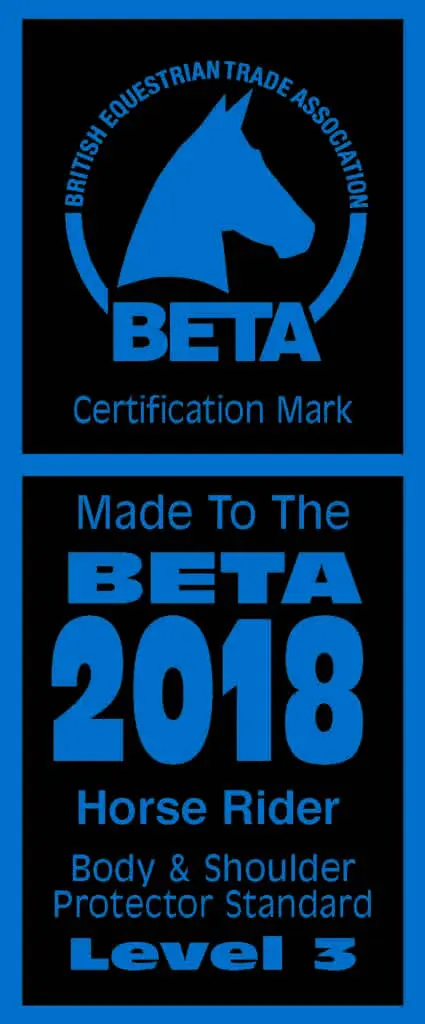
- British Equestrian Trade Association (BETA) has produced a guide summarizing the standards involved in different levels of protection.
- The BETA 2009 and 2018 Body Protector Standard meets all the requirements of the respective European standard (EN 13158). A revised edition of the BETA standard was published and adopted by BETA in 2018.
- The BETA Standard sets criteria for shock-absorption, controls the area of the body that must be covered and ensures there are minimal gaps between the protective foam panels. It encompasses three levels, each designed for different activities and denoted by a colour-coded label on the garment.
• Level 1 – provides the lowest level of protection that is only considered appropriate for licensed jockeys. Level 1 is designed to meet the weight restrictions that apply to professional jockeys whilst racing.
• Level 2 – offers a lower than normal level of protection. It is considered suitable for general riding in very low risk situations and for professionals such as licensed jockeys when specified by their racing authority or regulatory body.
• Level 3 – is considered appropriate for general riding, competitions including eventing and working with horses. Level 3 body protectors should prevent minor bruising that would have produced stiffness and pain, reduce soft tissue injuries and prevent a limited number of rib fractures - Body protectors must be worn by all jockeys racing under BHA rules and all competitors riding cross country courses under BE rules. Similar rules are normally adopted by unaffiliated competitions such as Hunter Trials. Many riders wear them at other times such as when riding on the road and schooling young horses.
- There is no guidance about whether body protectors should be worn out of competition.
- Current body protectors are more comfortable and tend to mould to the rider more than earlier types. Modern garments are more flexible and lightweight than their predecessors. Not only that, 21st century body protectors come in fun, fashionable colours (or plain if you prefer), are quick and easy to put on – and don’t necessarily cost as much as you may think.
- It’s important to choose the body protector that suits you best. There are variations in style of manufacture which includes the foam protection being arranged in larger sheets or panels, small blocks or more recently hexagons! Most have front zips although there are foam panel types without zips. Weight, comfort, freedom of movement and length at the back are all important.
- Your body protector should be fitted by a trained retailer whilst you sit on a saddle. Does it push your arms out? Does the back catch on the saddle too much?
Now you have read our blog – Top 12 things horse riders need to know about Body Protectors – You can learn how to manage a casualty wearing a body protector on one of our Equestrian First Aid courses. To find out which first aid course is best for you check out our specific equestrian first aid webpage.
Find out more about air vests and jackets.
We have also produced an equestrian specific Accident Book for horse riding establishments. You can view and buy it here.

Medi-K and First Aid Training Co-operative have come together to run specialist equestrian specific first aid courses. For more information about our first aid courses please contact us.