
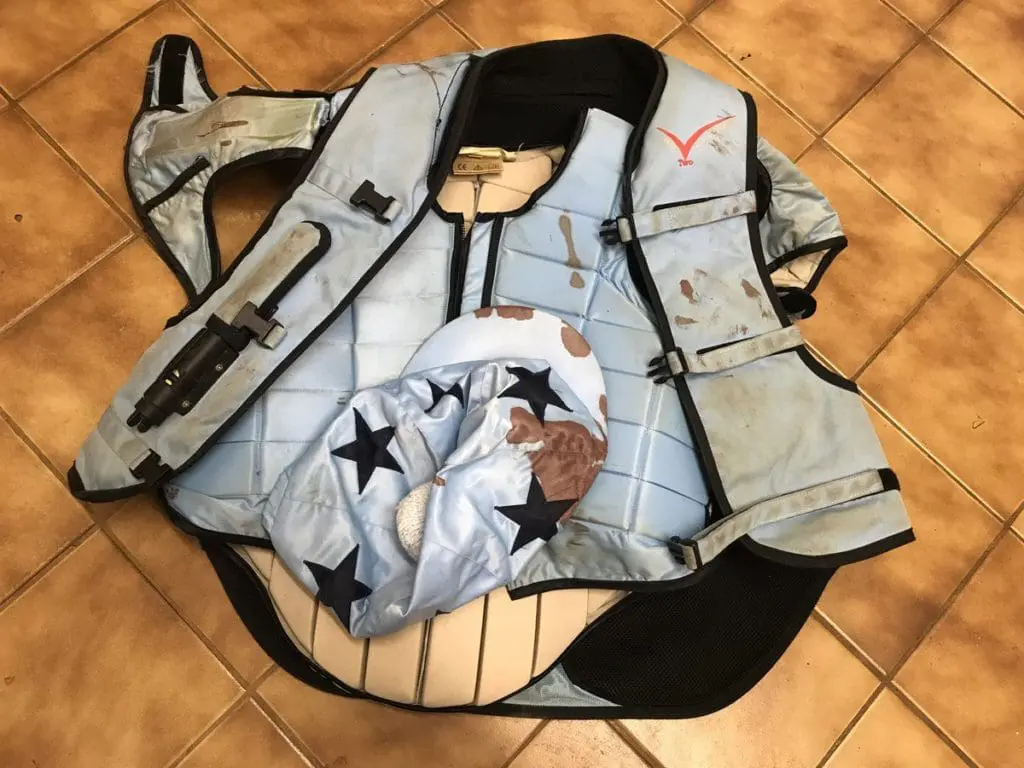
Top 10 things horse riders need to know about Air Jackets and Air Vests
- Air jackets/vests are made with airbags which inflate when the rider is thrown from the horse. The vests have a lanyard that attaches to the saddle or stirrup bars
- When a rider falls from the saddle, the lanyard triggers the activation device, which punctures an air canister, instantly inflating the vest before the rider hits the ground
- An air vest is designed to help provide protection by decelerating or slowing down the impact. It does not absorb shock. Which is why BETA, the FEI and BE insist that if you are wearing an air jacket it must be worn with a body protector to give the correct impact protection. For more information, download the BETA Guide to Body Protection
- Air vests will inflate in less than a tenth of a second and will stay inflated to support and protect the rider for 15 – 20 seconds
- It will take 2-3 minutes for the Air Jacket to deflate completely, unscrewing and removing the canister will speed this up significantly
- An air vest provides only temporary, dynamic protection once the garment is inflated. Research has shown that air vests are most suited to flat falls on wider, load-bearing surfaces but offer little protection on impact from sharp or blunt smaller objects such as hooves, poles and edges.
- Air vests are designed to be reusable, by simply re-setting the mechanical lanyard system and changing the CO2 canister, as long as the air vest is in good condition (no holes, tears)
- It is that important air vests are serviced regularly, usually annually
- CO2 canisters cant be reused, once the air vest has been deployed the canister needs to be replaced
- British Equestrian research focusing on rotational falls, and concluded that air vests can reduce the risk of serious injury by 13%. In a series of controlled tests were carried out, in which an equine cadaver was dropped on to a crash test dummy wearing a BETA 2009 Level 3 body and shoulder protector, and an air jacket. The results showed that the air jacket reduced compression, and that the predicted risk of severe chest injury fell from 94% to 81%.
You can read our blog on body protectors. To find out which first aid course is best for you check out our specific equestrian first aid webpage.

Medi-K and First Aid Training Co-operative have come together to run specialist equestrian specific first aid courses. For more information about our first aid courses please contact us.