Summary
Summary:
1. As soon as we realise a drowned casualty is not breathing, we're going to give them five rescue breaths.
2. Then we do 30 compressions, two breaths, 30 compressions, two breaths, 30 compressions, two breaths.
3. Then we call 999 / 112
4. While waiting for help to arrive we’re going to continue our CPR protocol of 30 compressions, then 2 breaths continuously.
Updated June 2026.
How should you perform CPR on a drowning casualty? It’s a different protocol from the ‘normal’ CPR method. Watch our video or read the step by step guide below.
How To Perform CPR on a Drowning Casualty in 10 steps:
- Stop and assess for danger and make sure it’s safe for you to proceed.
- Get them out of the water. If they’re lying in the water, drag them out of the water onto the shore, vessel or board. Lie them on their back on a hard surface such as the sand or deck.
- Consider cross contamination issues – use gloves and a CPR face shield.
- Check their alertness – AVPU. Are they wholly Alert, only responding to Voice commands, only responding to Pain or totally Unresponsive?
- If totally unresponsive, shout for help!
- Check their airway – tilt their head back, lift their chin and look inside their mouth. If there is obvious sea water, sand or seaweed in there, tilt their head and shoulders to the side and pat them firmly on the back to help it out. Then put them carefully back onto their back. Check their airway is now clear.
- Check their breathing – Look, listen, feel – Look at their belly whilst putting your face sideways onto theirs – you can then listen for breathing and feel any breaths. Do this for up to 10 seconds, counting the breaths. There should normally be between 2 and 3 breaths in 10 seconds.
- If they’re not breathing effectively or at all, give them FIVE rescue breaths followed by 1 minute of CPR in cycles of 30 chest compressions to 2 rescue breaths. Hands in the centre of their chest, arms straight, shoulders over your hands, press the chest by five to six centimetres. The rate is 100-120 compressions per minute. This initial response gives them some oxygen circulating in their system immediately and gives them a better chance of recovery.
- THEN phone 999/112 immediately and ask for an ambulance, tell them where you are and that you’ve got a non-breathing unresponsive casualty who you suspect has drowned. Once the emergency services are alerted, you must continue with CPR – 30 compressions to 2 breaths – continuously until help arrives. Get others to help with the compressions to share the workload as it is a physically demanding technique over time. Expect the casualty to vomit – if they do, move their head and shoulders sideways to help it come out. Then ensure their airway is clear afterwards then continue with CPR.
- Continue CPR and Monitor / Re-assess your casualty. With this sequence the casualty might have a re-oxygenated bloodstream and the heart might start beating effectively again and you may see signs of circulation. The casualty might flush pink and we might see signs of life. Don’t stop CPR until they’re effectively breathing around 12-18 breaths per minute or 2-3 every 10 seconds or they become wholly alert or alert to voice command or pain and are breathing on their own. If you’re sure they’re breathing on their own, put them in the recovery position and monitor them until the ambulance arrives.
A few points to remember about drowning:
Drowning is when your lungs are overwhelmed by water and the heart and brain are deprived of life giving oxygen. Drowning does not always lead to death but can lead to life changing illness or injury due to the impact of airway impairment for a period of time.
The potential of cold water shock often accompanies drowning. It is crucial to identify they are drowning and immediately deal with the situation. Read more Cold Water shock here.
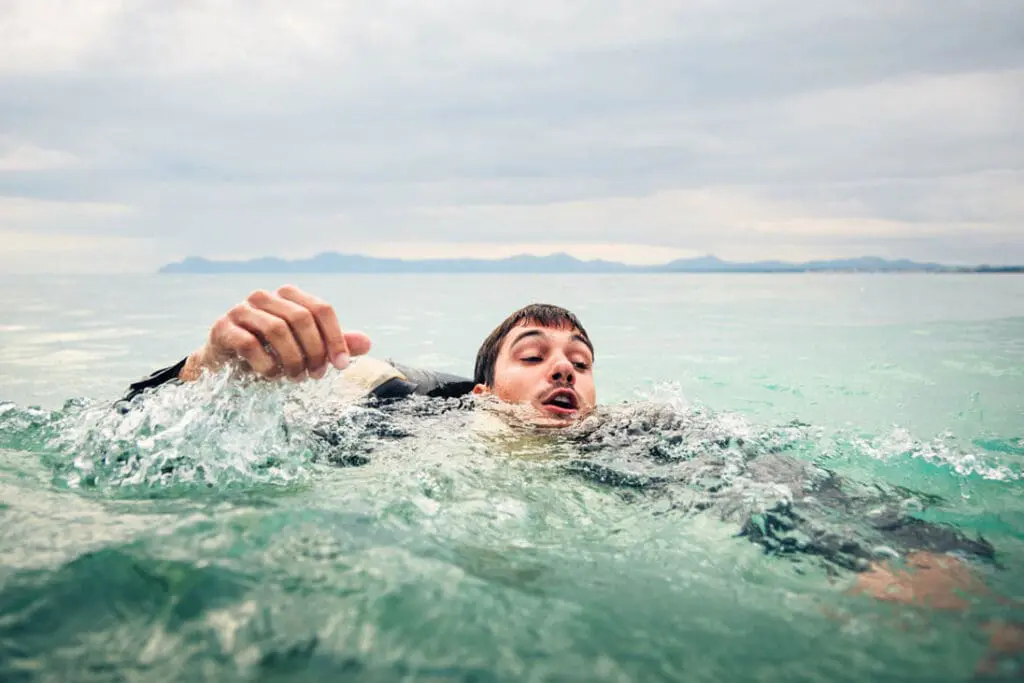
Drowning is not like in the movies – someone who is drowning will not be able to shout, wave or splash about. They will be still and quiet and struggling to use their limbs. However, if someone IS shouting or waving, they WILL probably need help before things get worse for them.
Summary:
1. As soon as we realise a drowned casualty is not breathing, we’re going to give them five rescue breaths.
2. Then we do 30 compressions, two breaths, 30 compressions, two breaths, 30 compressions, two breaths.
3. Then we call 999 / 112
4. While waiting for help to arrive we’re going to continue our CPR protocol of 30 compressions, then 2 breaths continuously.
Get confident – get trained!
Knowing what to do BEFORE it happens is essential and attending a first aid course will give you the knowledge and the confidence to deal with many swimming related first aid incidents. We are the largest provider of public Outdoor First Aid courses in the UK and our courses comply with the requirements of Sports Governing Bodies so you know they are relevant as well as useful. Find out more about our Outdoor First Aid courses here.
Our digital First Aid Manuals and First Aid Video Channel:
Every client on our courses receives a FREE Digital First Aid Manual relevant to the course they come on. You can also view and buy our manuals in our online shop. In addition, we have our own YouTube channel with over 40 practical first aid videos.