
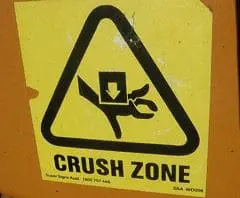
What is a Crushing Injury?
Dealing with crushing injuries is often complicated and time critical. Often, there is little visible damage on the outside. But this belies the fact that the damage that has occurred on the inside. Crush injuries occur when a part of the body, such as a hand, arm, leg, foot or trunk is squashed.
Crush injuries most often happen:
- In motor vehicle accidents
- In tractor or quad bike rollovers
- While using or moving heavy equipment
- When moving large silage bales, logs and unstable loads
- While dealing with large animals in yards, crushes or small spaces
Crush injuries are also common following natural disasters, when buildings collapse, and in road accidents when people may be trapped between or under vehicles.

They are most common on farms and in forestry, where hands are particularly at risk. The most serious agricultural and forestry cases occur when heavy machinery is used with casualties becoming trapped under them or in-between moving parts. Forestry workers are also at risk from heavy timber in movement, or collapsing timber stacks. Visitors to forest areas are also at risk if they play or climb on unstable log stacks. Horse riders are also at risk from falls with their mounts.

First Aid for Crush Injuries
The limb or crushed part will look swollen and be very painful. The skin will look stretched and discoloured.
We will consider STANDARD first aid and REMOTE first aid for crush injuries separately.
STANDARD / URBAN First Aid Protocol for Crushing Injury
For crushing less than 15 minutes:
- Release the compressive force, or object, as quickly as you can.
- Dial 999.
- Control any bleeding.
- Treat for shock.
Crushing injury treatment needs quick action. 15 minutes can pass in the blink of an eye when a situation is stressful. If the compressive object can be moved, do it quickly.
For crushing more than 15 minutes:
- DO NOT release the compressive force or object.
- Dial 999.
- Monitor and reassure patient.
REMOTE First Aid for Crushing Injury
- If help is not immediately available, consider removal of the crushing object BUT apply a tourniquet above the injury site BEFORE lifting the object. This will help to prevent the sudden release of toxins into the circulatory system. Ensure the tourniquet is sufficiently tight. Write the time applied on the tourniquet or on the casualty.
- Dial 999 or alert emergencies services as soon as possible. Say that you have applied a tourniquet.
- Raise the limb above the heart if practicable.
- Monitor the crushed limb, the casualty’s vital signs and reassure the casualty. Read more in our blog on how to monitor a casualty’s vital signs
- Be prepared to treat for shock. Signs of shock are anxiousness, pale , cold clammy, rising pulse and breathing rate. Raise their legs and ensure they’re lying down if practicable.
- Check for other injuries and deal with them if practicable or note them for Emergency Services.
- Ensure the casualty maintains a good urine output as muscle damage can worsen kidney function. If the urine is tea coloured, notify the Emergency Services.
Crush injuries involving animals.

When an animal falls on top of a casualty or crushes them against a barn wall or gate, internal injuries may be expected. Quick removal of the animal and assessment of the casualty is paramount.
Most animals such as horses that fall onto a rider will make an effort to get up fairly quickly after the fall. Animals that are injured however will need to be removed. In a racing or eventing setting , there will be provision on site for the safe removal of the animal using hobbles, compression air bags or similar equipment.
In a livery yard or an agricultural setting where the animal is injured and lying on a casualty or part of a casualty, finding the correct equipment such as forklifts, winches or pinch bars may be the best and safest solution to quick removal. If you’re working alone, this emphasises the ned for some means of communication or alarm during field work. Thinking about the solutions before you need them is key to good farm and equestrian businesses.
What is Crush Injury Syndrome?
Crush Injury Syndrome is a potentially life-threatening condition. It describes the release of toxins and the resultant impact on the body. This most often occurs if the casualty themselves, or just their affected body part, is trapped for some time. It is the manifestation of muscle cell damage resulting from pressure or crushing. The severity is related to the magnitude and the duration of the compressing or crushing force.
For Crush Injury Syndrome to occur it must:
- affect a large area such as an entire arm or thigh
- be present for some time
- blood circulation to the area has to have been obstructed during that time
In this condition, toxins produced by the breakdown of cells in the body are trapped by the compressive (crushing) pressure. Removing the pressure can cause the sudden release of toxins into the circulatory system. This can potentially overwhelm the kidneys.
Not all crush injuries progress into Crush Injury Syndrome. For example, a crushed finger is very painful, but not a large enough part of the body to cause Crush Injury Syndrome.
Why is Crush Injury Syndrome life threatening?
In a crushing incident where the crushing pressure is not released immediately (or within 15minutes), the ‘pinned own’ body part may progress into crush injury syndrome. This is localised but can seep or be released into the whole body with life threatening results.
The mechanism is believed to occur as a result of the release into the bloodstream of muscle breakdown products—notably myoglobin, potassium and phosphorus. The most devastating effects can occur when the crushing pressure is suddenly released, without proper preparation of the patient.
The process, called rhabdomyolysis, causes systemic organ dysfunction, such as acute renal (kidney) failure.
Releasing the compressing pressure or force can also cause other fluids to leak into the injured area, resulting in Hypovolaemic Shock.
Other effects include increased pulse rate and changes in chemical balance in the heart potentially leading to cardiac arrest.
First aid for Crush Injury Syndrome:
- Phone 999.
- Check their airway, breathing and circulation (ABC)
- Check and administer first aid to any other bleeding injuries. Think about the ‘mechanism of injury’ and possible resultant traumas. Check the casualty thoroughly for other injuries and deal with or make a note of them.
- Treat for shock – keep the casualty warm and dry and protected from outdoor elements.
Will the casualty lose their limb?
If a limb is trapped or tourniqued for too long, there is always a risk of losing a limb. However, this is much reduced these days as evacuation to hospital is much quicker by land or air ambulance enabling urgent surgical treatment. Also, treatment on site by first aiders, ambulance crew and doctors plus the fire and rescue services if required all lead to a quicker, more effective journey through to the operating theatre. The old adage of ‘lose a limb, save a life’ still applies. However, always reassure your casualty that very few amputations happen these days as a result of crush injuries. ???
What is Compartment Syndrome?
Compartment Syndrome can happen as a result of a crush injury or a bone fracture. Compartments are groupings of muscles, nerves, and blood vessels in limb, surrounded by a non-elastic membrane called a fascia. Compartment syndrome develops when swelling or bleeding occurs within a compartment. Because the fascia does not stretch, this can cause increased pressure and restrict the blood flow, oxygen movement and waste removal leading to tissues ‘dying off’ due to lack of oxygen and nutrients.
Symptoms can start suddenly due to the restricted flow of oxygen and nutrients in the affected part. This is Acute Compartment Syndrome.
They can also come on gradually after exercise for example – this is usually Chronic Compartment Syndrome. This most commonly happens in lower legs and forearms.
Symptoms of Compartment Syndrome:
- Pain in the muscle – deep burning pain made worse when moving
- Swelling or bulging in the affected area
- Pins and Needles or weakness in the area
- Tightness or difficulty moving the affected limb
First aid for compartment syndrome
Identification of the syndrome is the key factor here. There is nothing practical that a first aider can do except recognise – or suspect – compartment syndrome. If in doubt, phone 999 (for severe pain and sudden onset) or 111 (chronic pain after exercise) and they will help with your diagnosis.
If the symptoms come on quickly – get urgent medical help. Phone 999. DO NOT elevate the limb as this will further reduce the flow of oxygen and nutrients to the affected part.
If the symptoms appear after exercise – see your GP. (‘Shin splints’ is a type of chronic (post exercise) compartment syndrome and is usually relieved by adaptations to footwear, physiotherapy or changes to exercise type.)
Get confident – get trained!
The best way to feel confident about dealing with first aid incidents is to take a specialist first aid course. At First Aid Training Co-operative we run 1-2 day outdoor, forestry and equestrian first aid courses which not only cover the basics but also how to manage serious accidents such as crush injuries. Click here for full course details.
Everyone on our courses receives a FREE digital first aid manual. We have a range of manuals relevant to the courses we teach – Outdoor, Equestrian, First Aid at Work, Paediatric and Sports. They are a great resource that you can download onto your phone or other device and have all that first aid knowledge at your fingertips. You can view them and buy them for less than £4 here.