In this post we’re going to look in more depth at Managing Catastrophic Bleeding, how it differs from ‘Significant’ bleeding, and what should be done to manage it.
Catastrophic bleeding is becoming more a part of the public consciousness thanks to increasing numbers of terrorism incidents and incidents involving mass casualties such as natural disasters worldwide. However it has been in the parlance of the Military, Rescue teams and of some sectors such as the Forestry industry for some time. Managing Catastrophic Bleeding forms part of the ‘+F’ requirements for first aid for forestry workers.
What is Catastrophic Bleeding?
Catastrophic Bleeding is defined by the UK Ambulance Services Clinical Practice Guidelines 2013 as: “Extreme bleeding likely to cause death in minutes.” It is also increasingly being called ‘Severe Bleeding’ or ‘Life Threatening Bleeding” and these terms are essentially interchangeable.
They differ from what we term a ‘Significant’ Bleed mentioned on first aid courses. Significant bleeding forms a puddle of blood, or will soak clothing. It is typically estimated as where the adult casualty has lost c. 250mls or 1/2 pint of blood. Although dangerous, significant bleeding does not mean the casualty’s life is in immediate danger.
Catastrophic Bleeding however, means that the casualty could be losing litres of blood. The wound will be ‘gushing’ with blood or blood may be ‘pumping’ or ‘flowing’ out. It is commonly said amongst emergency medical personnel that catastrophic bleeding is the type of bleeding you can hear!… In any case, we must act immediately to save their life.
Catastrophic bleeding is usually associated with amputations, or significant damage to major blood vessels. These are usually caused by lacerations or complicated fractures where the broken bone damages blood vessels. If you want to see what this looks like in real life, this video of mountain biker Cedric Gracia is very instructive, and not too gory (but does show a LOT of blood).
How can I stop Catastrophic Bleeding?
Put simply – check airway – check breathing – then stop the circulation leak!
Apply pressure – The first rule of bleed management is applying direct pressure to the wound. Use your hand, finger or knee if required to put enough pressure on the wound area to limit the bleeding. The leak is coming from an artery which is smaller in diameter than your finger, so focus on the area and get your (gloved) fingers in there, LOTS of pressure will be required to stem the flow. There is a lot of blood pressure to fight against, so press hard!
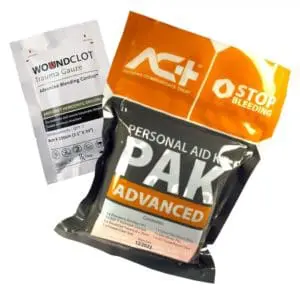
Pack the wound – Where there is a lot of blood, we will need to use something to pack the wound, and we will still need a lot of pressure. There are specific bandages – haemostatic dressings and tourniquets – available that help us do that more effectively. Their use is explained in this blog in much more detail. There is also specific training available on our 3hr Managing Catastrophic Bleeding course.
Improvise if required! If we don’t have the correct equipment to hand, we need to improvise with anything absorbent to pack the wound and apply pressure. Bandages and clothing are likely to be the best option. We can also improvise a tourniquet if required by using a bandage or any suitable strap, with a stick used as a windlass to wind up the pressure on the limb.
Get help – If someone else is with you, they can check airway and breathing while you get into the wound to stop it bleeding. Another person can also phone 999 for you and help reassure the casualty.
Time is crucial if you’re alone – If you are alone with a casualty with a catastrophic bleed, you may want to deal with the big bleed before you do other checks as they may ‘bleed out’ or bleed to death by the time you do other checks. Get pressure on the wound whilst checking their alertness, airway and breathing.
Why should I learn more about Catastrophic Bleeding?
Essential skills and easy to use equipment – Our Managing Catastrophic Bleeding course has been developed and is run by members of our Senior Training Team. It is suitable for anyone who wants to take their understanding of bleed management to the next level. It is ideal CPD for first aiders with any level of experience but particularly those who work in dangerous environments such as forestry, some outdoor sports, or where a terrorist attack is an identified risk. We also cover catastrophic bleeding techniques in our Advanced Outdoor First Aid course.
Unexpected injuries – It is also a useful skill to understand as catastrophic bleeds often happen in unexpected places where you don’t perceive life threatening danger. For example, falling off the roof of a house, road traffic accidents and during some sporting activities.
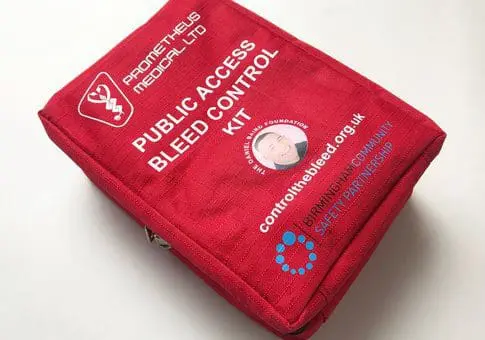
Incidents in Public places – You may have seen publicly accessible trauma or bleed control kits such as those above more frequently in cities around the UK. These are likely to become more commonplace and are usually located near to defibrillators in transport hubs, entertainment foyers etc. Although designed for lay people to use, doing our Managing Catastrophic Bleeding course will mean you are much better prepared should the worst happen.
Specialist bleeding management items found in a Bleed Control Kit are easy to use, extremely effective, and can save a life. Learning how to use them properly makes them even more so.
Get confident – get some first aid training
We use and discuss bleeding in all of our First Aid courses. Our systematic approach to teaching first aid helps your learning and understanding of many illnesses and injuries. Practicing first aid techniques reinforces your learning too. Find our more about our full range of First Aid Courses here.
Every client on our courses receives a FREE Digital First Aid Manual relevant to the course they come on.
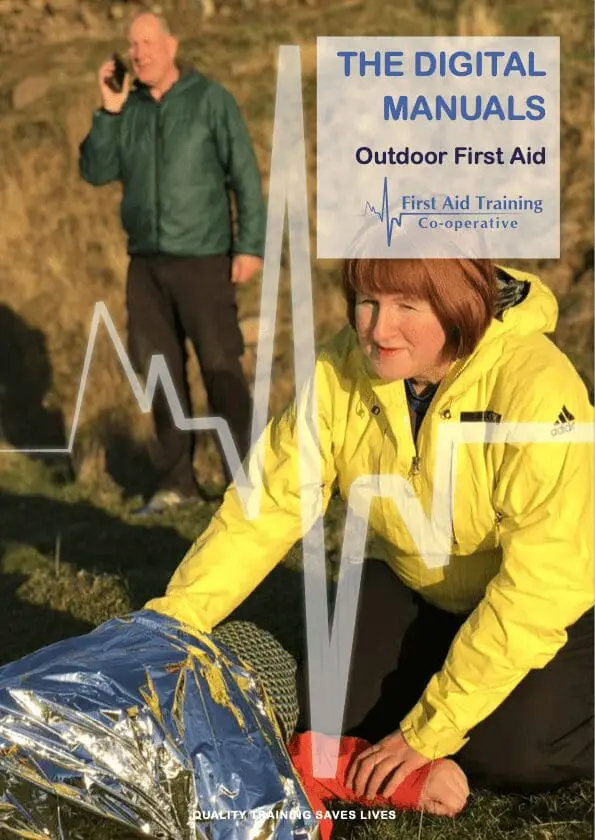
Our digital Outdoor First Aid manual covers different types of bleeds in urban and remote settings. Everyone on our outdoor courses receives one free. We also produce manuals for equestrian, paediatric, sports and workplace settings. All available via our on line shop.